
 Sheng Peng
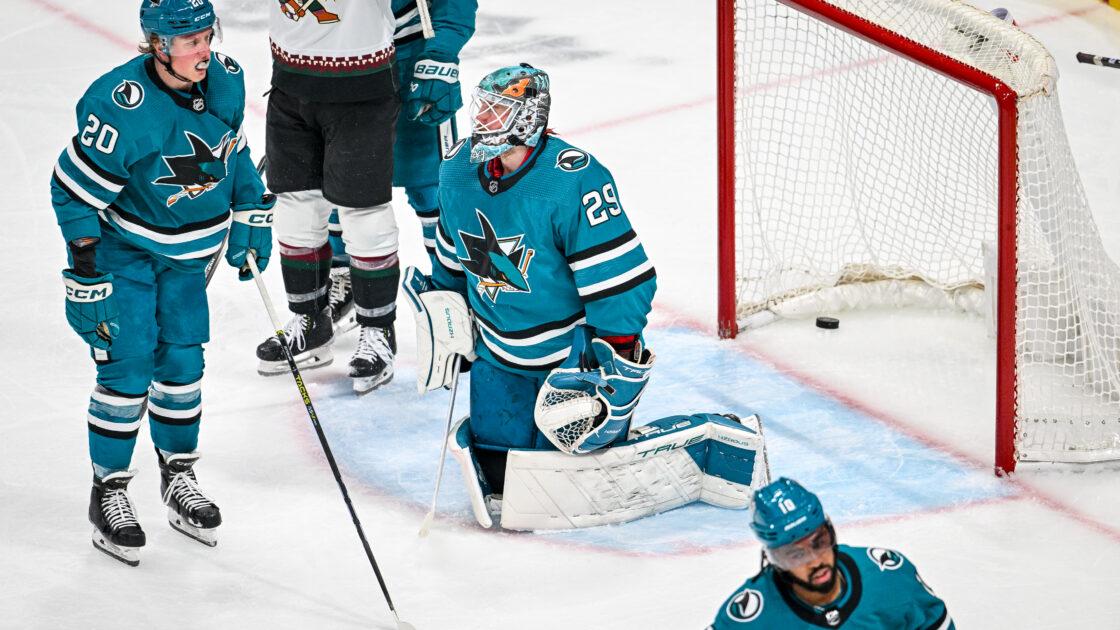
LOS ANGELES — The San Jose Sharks have a lot to learn.
That’s no hot take: They’re 9-22-3 for a reason.
If they want to start to turn that record around – if not this year, next year – there’s one area of improvement that a 5-2 loss to the Arizona Coyotes last week magnified.
“We cheated for offense,” head coach David Quinn lamented.
What did he mean by that? Cheating for offense is one of those hockey cliches, but it’s not as simple as someone cherry-picking for a breakaway.
It’s something that young – and not very good – teams are often guilty of. But it’s also something, if the San Jose Sharks can do less, will be a key step toward transitioning out of the rebuild.
Two Coyotes goals, in particular, came from the Sharks cheating for offense. Quinn spoke on that, along with an ex-NHL assistant coach who also shared his wisdom.
Early in the second period, Anthony Duclair had just tied the game at one apiece on a breakaway, and two minutes, San Jose returned the favor.
Before we revisit the clip, let’s set it up:

The San Jose Sharks have a rush chance.
Jan Rutta (84) on the top right is changing, Jacob MacDonald (9), playing defense that night, is jumping on for Rutta. Winger Kevin Labanc is covering for Nikita Okhotiuk (83), who’s joined the rush. Justin Bailey (90), along the wall, is trying to hit Okhotiuk with a pass into the slot.
Of course, that pass doesn’t connect.
“It was just shoveled to an area,” the ex-NHL assistant coach complained.
That Bailey hope pass was just one example of cheating for offense.
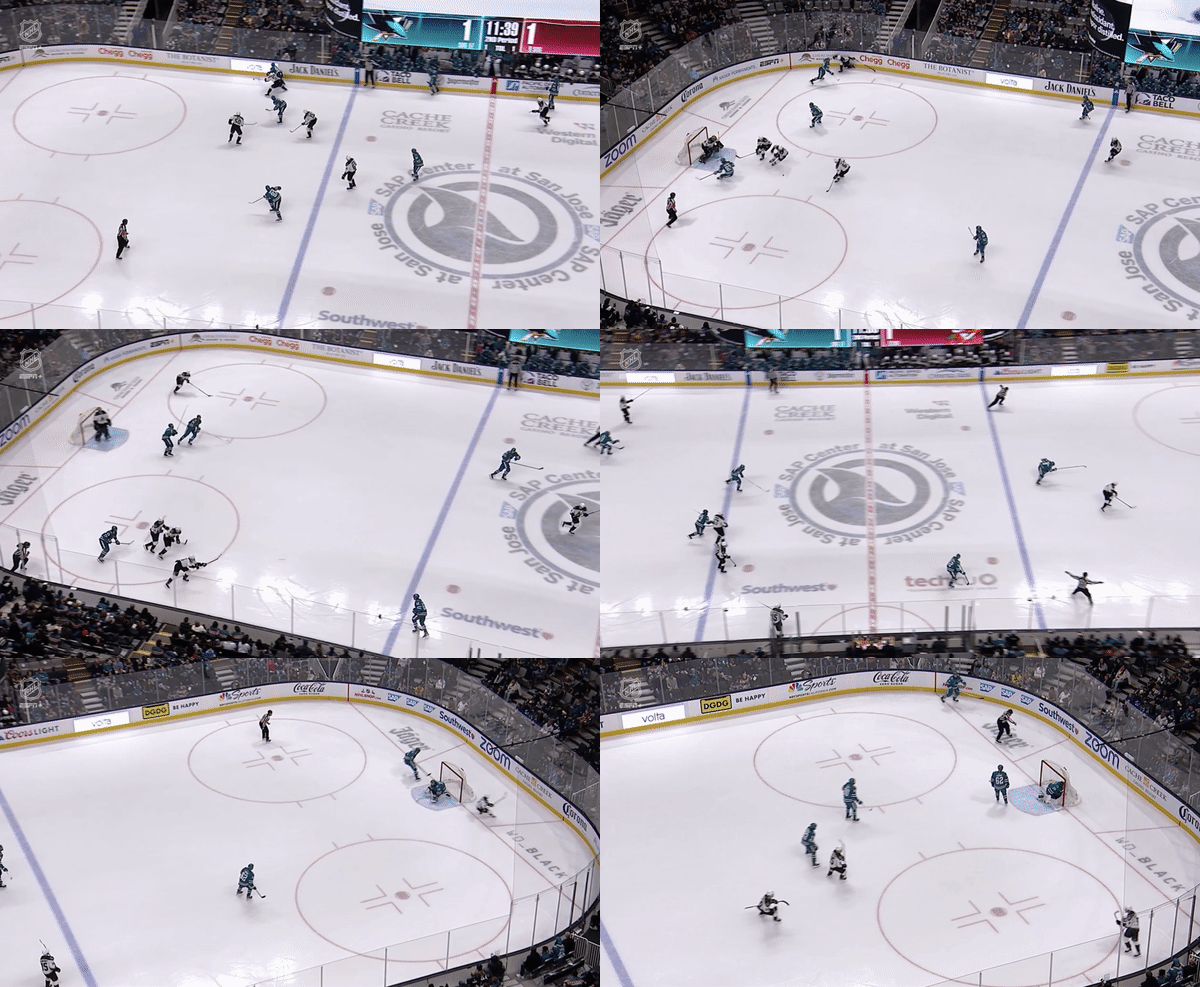
This coach was not impressed by what he saw from MacDonald and Labanc. While they weren’t wrong to man the points, they’re the defensemen on this rush, they needed to account for Clayton Keller (9) behind them.
“You got to be counting numbers. Not only your own team. But you gotta be aware of what’s going on in front of you and behind you,” the coach said of MacDonald. “It appeared to me that he got mesmerized by the puck, and looking at the clip, he [seems] unaware of Keller behind him.”
Puck-watching is a common no-no on defense, but that’s an example of puck-watching on offense. MacDonald is also cheating for offense.
Then, when Alexander Kerfoot (15) intercepts the Bailey pass, the coach wasn’t sure why Labanc took that particular skating route.
“You also see [MacDonald’s] partner pivot outside the dots. If you pivot, you open up the middle,” he explained. “Your back, your two guys need to stay connected, and preferably, inside the dots. If those back two guys are closer together, there’s not a great likelihood that the pass would be made in the first place. But because it was a gaping hole, [Keller] had the green light.”
Big picture, this goal is pretty much a five-man mistake. Hope pass by Bailey. Luke Kunin (11), according to this coach, could’ve done a better job of forming an attack triangle, which might’ve given Bailey another passing option and also formed another defensive layer (instead of all three “forwards” being on the same plane – and behind the puck – when the turnover occurs).
And of course, the two wayward “defensemen”.
“We always used to talk about the forwards work for the D and the D work for the forwards, one hand has to know what the other one’s doing,” the coach said. “They kind of lost their structure upon the turnover.”
The San Jose Sharks head coach was especially agitated by the Coyotes’ next goal, the eventual game-winner.
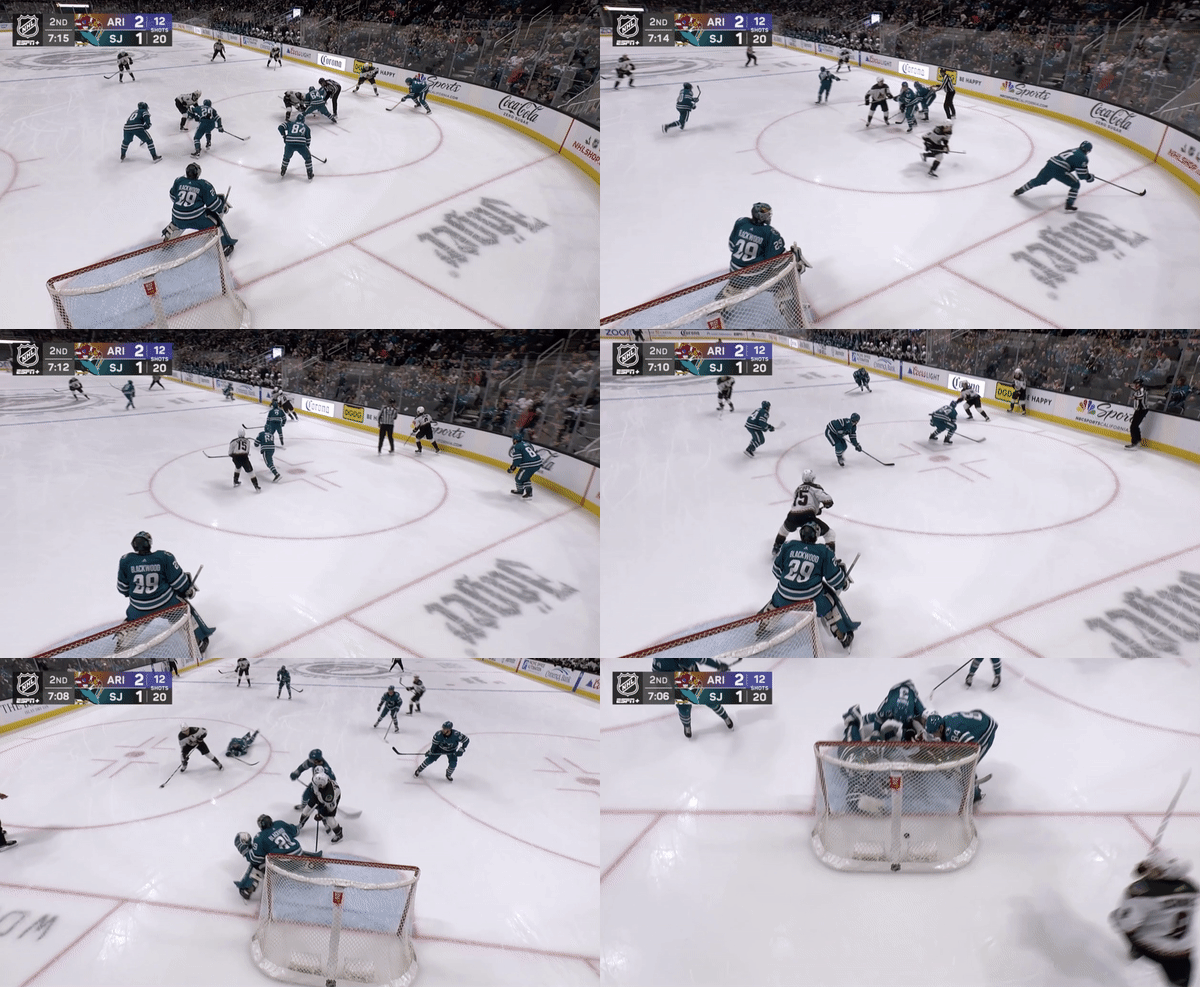
“The kick in the ass was the third goal, the faceoff. We win the draw, and it ends up in the back of our net,” Quinn said. “It can’t happen. It just can’t happen. That really pissed me off. It just can’t happen.”
Rutta is the obvious culprit – after all, it’s officially his turnover.
But don’t blame him: Think, for example, in football, when a quarterback throws an interception, but it’s mainly because his receiver ran the wrong route.
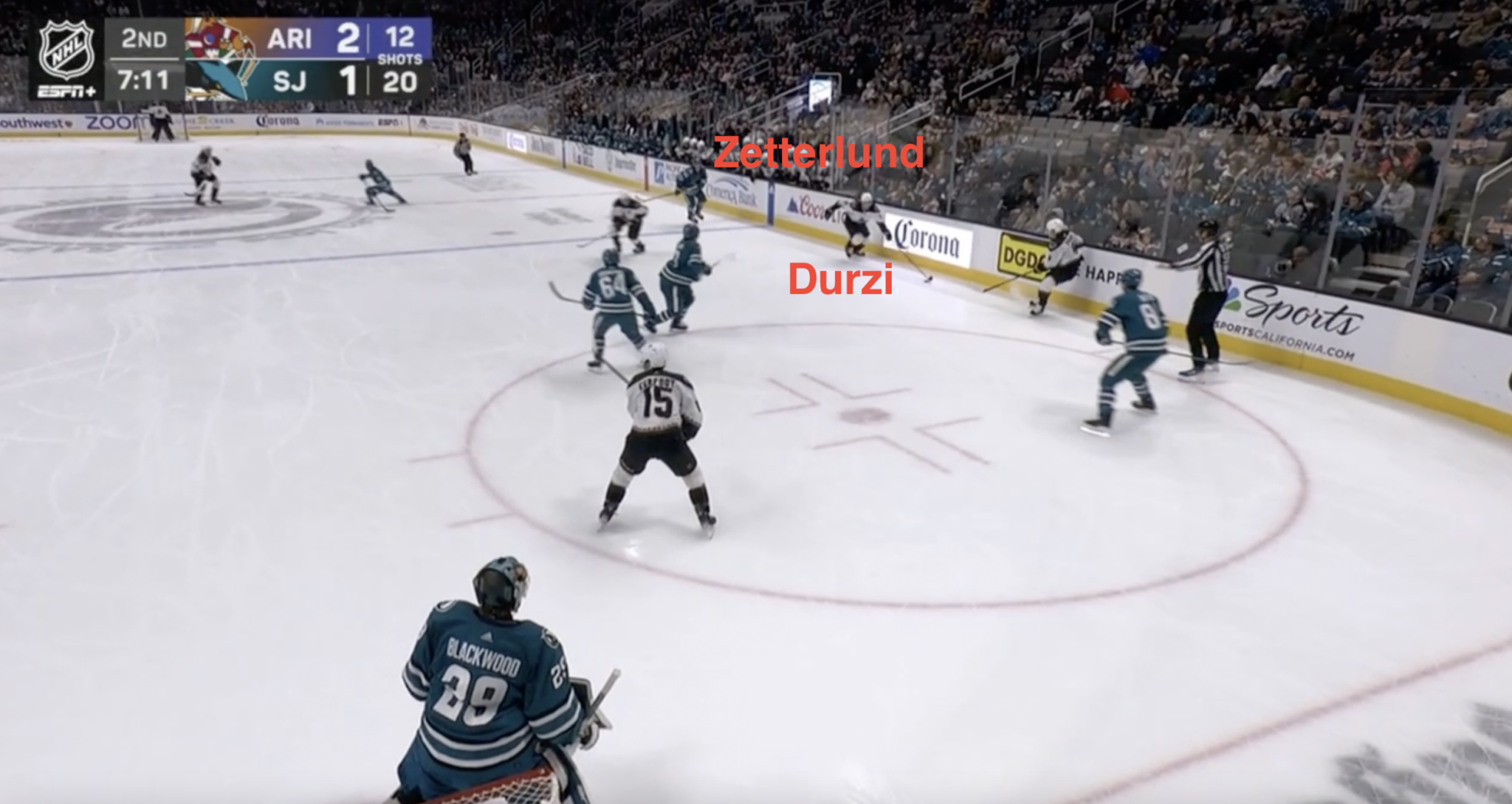
The receiver who ran the wrong route, in this case, is Fabian Zetterlund (20).
“The play there, D throws it up the glass, the winger can’t get behind the defenseman until it’s by him,” Quinn said.
Essentially, Zetterlund is going for the long bomb, a highlight-reel pass that stay-at-home defender Rutta is not likely to complete, instead of trying to chip the puck past Sean Durzi (50) or at least getting into a puck battle with the blueliner at the point.
“We get behind the D, [he] keeps it in, it’s a goal. It’s cheating for offense,” Quinn said.
This isn’t the only mistake on this goal, but the initial error is Zetterlund’s and not Rutta’s. With Durzi ahead of Zetterlund, it’s now an Arizona 4-on-3 in the OZ.
Then, Henry Thrun (3) ties up Kerfoot in front, but the visitor gets a favorable bounce off his skate.
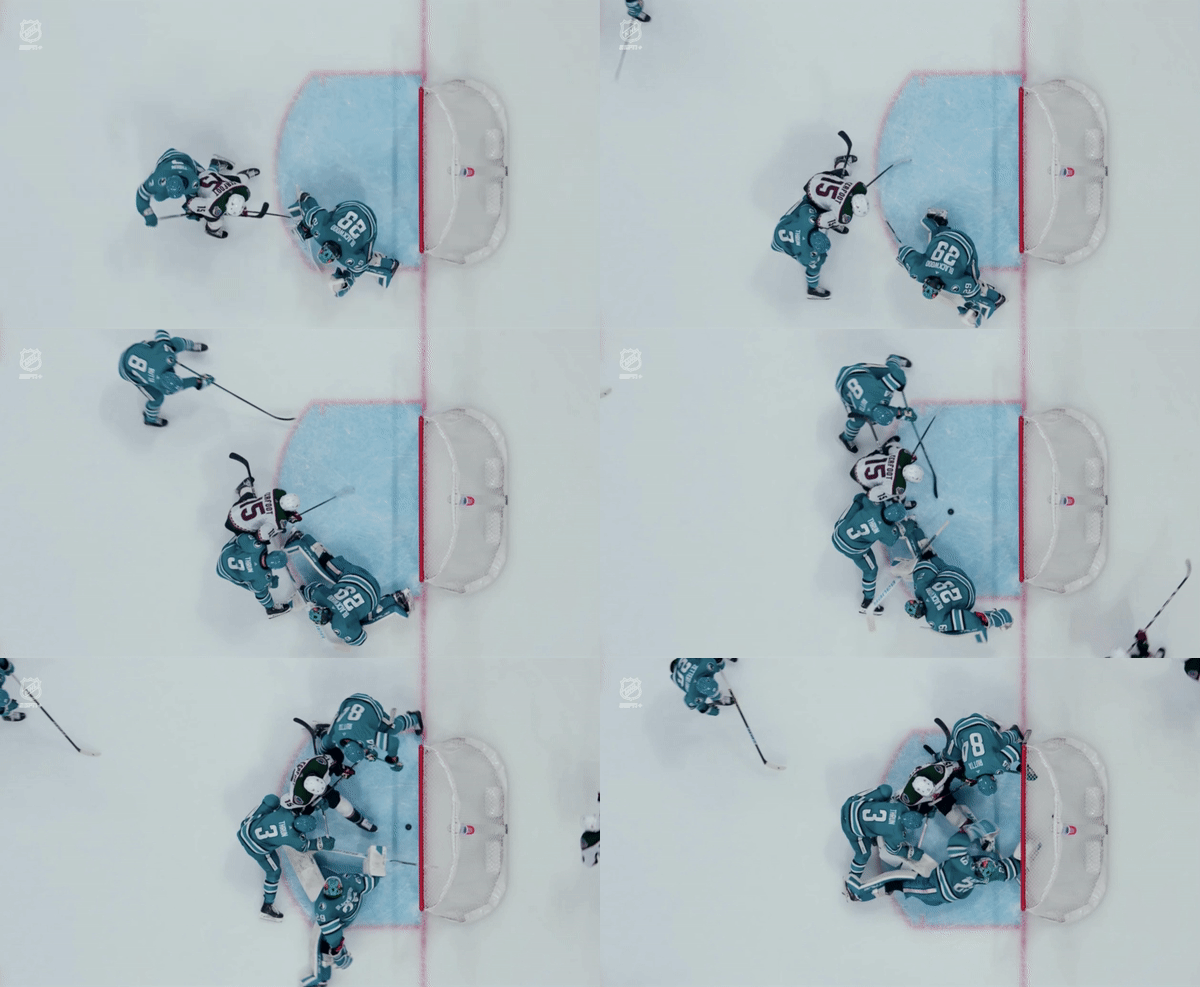
“I think puck-watching and forcing offense is starting to creep in. Not creeping, it’s in our game, it’s there,” Quinn said about the fourth consecutive loss in the San Jose Sharks’ current five-game skid. “Until we get back to being consistent with doing the right things, shift in and shift out, we’re probably going to be on the losing end.”
To get on the winning end?
It’s the next step in enlightenment. And it’s likely a long way from now.
“Offensive opportunities come from good, solid defensive structure,” the ex-NHL assistant coach preached.
Good defense will lead to good offense. Good defense and good offense will lead to wins.
But before the Sharks get there?
“Sometimes, failure is the greatest teacher, and this has to hurt so much, you say I don’t want to do that. I don’t want to feel like this, right? That’s really what it comes down to,” Quinn said. “How bad does it hurt to lose? Then you stop doing it.”