
 Sheng Peng
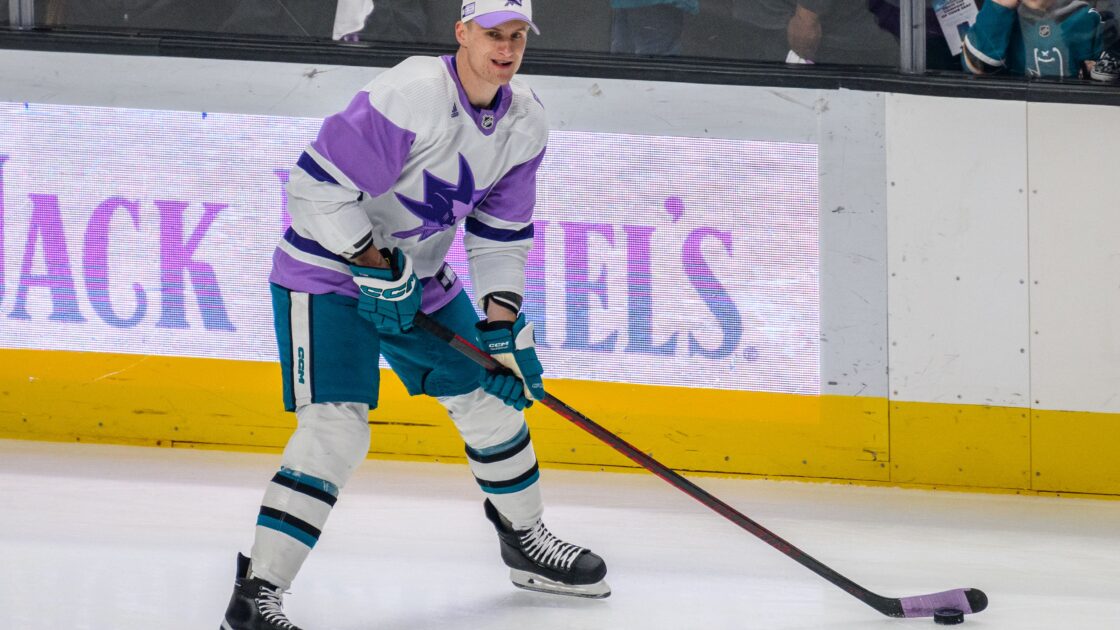
Nico Sturm hasn’t been with the San Jose Sharks for long, but he’s certainly made an impression.
Signed to a three-year, $6 million dollar contract this off-season, the 27-year-old pivot, originally projected to play fourth-line center, has become the team’s 3C and has provided surprise secondary scoring to the tune of six goals through 20 games.
He also leads the Sharks with a 58.7 Faceoff Winning % and is an integral part of their NHL-best penalty kill.
Off the ice, the 2022 Stanley Cup champion has become a fan favorite for his winning attitude and direct way of speaking, which took fans by surprise earlier this season after the Sharks dropped a 5-2 decision to the New York Islanders, their fifth-straight to start the season.
“He gives such an honest effort every game. He’s a smart player. Really looking to get better all the time,” Sharks head coach David Quinn said. “He’s better than I thought he was gonna be. I knew he’s a really good player. I knew him from his days at Clarkson, but he’s been really good for us.”
Nico Sturm was kind enough to answer San Jose Hockey Now subscriber questions last week.
And just like you might expect, Sturm was direct and honest with his thoughts about the trade rumors surrounding the Sharks, the difference between the defending champion Avs and struggling Sharks, his gameday routine, how Nathan MacKinnon influenced his teammates’ diets, and why he’s on a career-high goal-scoring pace.
Sheng Peng: You signed with the Minnesota Wild out of Clarkson in 2019. Were the San Jose Sharks interested too?
Nico Sturm: No, I don’t think that was part of the conversation back then, if I remember correctly.
SP: How many teams were very interested in you coming out of college?
NS: I had a lot of options. I don’t really care to give you an exact number, but you obviously boil it down. But it was over a dozen teams.
Some teams make more sense than others, right? You don’t want to really go to Stanley Cup-contending team right away. [You’re] probably not going to have a chance to find a spot a line-up on a team like Tampa coming out of college as an undrafted guy.
So you look for team that has a winning culture and maybe is on the cusp of going up there, but also where you think you got a chance. And Minnesota obviously, looking down the middle back at the time, they had with Mikko Koivu and Eric Staal, two great guys that I could learn from [as] mentors, but they’re also older, knowing that they weren’t going to play forever. So I just thought, “Hey, there might be a chance there.” And that’s how we boil it down. And at the end of the day, though, it was a gut feeling, no sure thing. Just boil it down, and then just go with what your gut tells you to do.
SP: You studied Financial Management at Clarkson, any stock tips for the readers?
NS: You know what, right now if [you] put some money in, you’re definitely gonna make it back because it can’t go that much lower.
SP: After you retire, do you want to get into financial management for athletes or something like that?
NS: I’m always thinking about the future and I got a lot of ideas. But it seems like it’s changing every week.
Sometimes I want to work in coaching or management, then I want to work in finance again, and then I want to be a skating coach.
I’m also still very interested in aviation, and being a pilot, but I might be too old for that by then.
There’s a lot of ideas floating around right now. I just get to play hockey [now]. I don’t think I’m at that point yet in my career where I have to think about [it], we always float around ideas, but I’m not at the point where I say, “Hey, what am I doing in two or three years?” I’ve still got a long ways to go, I think.
SP: Aviation, wow. You want to fly like Boeings, passenger planes?
NS: The flying bug caught me when I was a teenager and I always played a flight simulator at home. And actually thought about going to pilot school.
I just always loved being in airports and [going on] family vacations. I don’t know what it was, always all the lights at the airport that fascinated me.
[Flying is] just something that I’ve always been interested in, playing the flight simulator.
You can’t do everything in life, right?
I haven’t really played the flight simulator; I don’t really have time for that. But it’s something, you can get your private license and maybe fly a smaller plane.
So luckily, I think by the time I retire, hopefully, you’re in a privileged position to kind of pick and choose whatever you want. And hopefully, it’s not having to do like a nine-to-five job at a desk, I don’t think that’s something that suits me very well, to be honest. So whatever it is, it’s going to be something that I’m passionate about. And, I don’t know what that is right now.
SP: You mentioned being a skating coach, that reminds me, you’ve said your girlfriend Taylor Turnquist is an incredible skater. She just retired, right?
NS: Actually, she just signed a short-term contract with Boston [Pride], so she’s gonna play again. So she’s dusting off the gears coming out of retirement, at least for a couple of games. She’ll be back in action [this] weekend.
SP: That’s awesome! I was going to ask, what has she taught you about hockey?
NS: Well, I think the biggest thing about dating someone that played hockey at such a high level and had really good success too is that she’s got a good sense of where I’m at after games. She knows if you want to talk about it, if you [do] not want to talk about it.
Sometimes it’s good to just have someone there that has a lot of knowledge about the game too. She has her input there. And every once in a while, she tells me what to do.
So, it’s just nice to have somebody to talk to you, regardless of whether things are going good or bad.
I’ll watch, I tend to watch all my shifts after every game, and sometimes she has a little bit of input there as well. And, yeah, she’s knowledgeable. It’s always easier to talk hockey to somebody like that.
SP: How long is her comeback for?
NS: It’s officially short-term, I think they need players. I think they’re trying to sway her to come back full-time. I think if there was a team in California, she would definitely be playing full-time.
But we’ve done the whole long-distance thing.
It’s not easy to do. I think she’s at that point, too. We’re just prioritizing other things in our life and being together.
But I urge her to do whatever she wants to do. And if she feels like she wants to come back, that’s fine with me.
We don’t have kids. We don’t have a dog yet. So if there’s a time to do it, it’s definitely right now, because in a couple of years, you never know. You might not have the freedom of choice anymore, right?
SP: From what I understand, she was teaching special education. Is she doing that in California?
NS: No, it’s not that easy. Because the teaching license she has is in Minnesota, you can’t just go teach in another state. It’s actually really difficult. But that’s something I think when I’m done playing, I think that she’s gonna go back to that. She’s very passionate about that.
SP: And here’s one Sharks question before we get to some of the reader questions: Obviously, you signed a three-year contract over the summer. But I’m sure you heard the recent trade rumors, that Mike Grier may start to break up the team a bit. What is your reaction that that?
NS: I mean, when is there ever not talk about trades, it’s just part of the business.
I think they gave me a three-year deal for a reason. I think they know the kind of value that I bring to the organization. And a lot of that is off the ice as well.
So I would like to think of myself as a guy that’s worthwhile keeping around if you do want to rebuild. But at the end of the day, I also understand that it’s the business. But then again, I like to think that they gave me this deal for a reason.
I think so far I’ve done a pretty good job, but those are decisions that are not up to me. All I can do is control my effort off the ice and on the ice and let those guys make the decisions.
But all I can say for myself is so far, I love it in San Jose. And for the first time in my career, I get to not worry about the future, and just play. So far it’s reflected in my game as well, that I seem a little more confident and relaxed. Whatever happens, happens. That’s up to them to decide. I understand the organization is in a phase of transition. But for my part, I love it here and right now, I wouldn’t want to be anywhere else.
Devon Oropeza: How do you keep your teammates feeling positive and motivated during a game you’re losing, or have lost?
NS: It’s definitely different playing here than in Minnesota or Colorado, I’m not gonna lie to you. In Colorado, it was like winning eight [or] nine games, and then you lose one.
With that start that we had here, that was definitely something that I hadn’t experienced before [with] losing.
I think we lost [five] in a row. So I gotta be honest with you, that was a new feeling for me as well. I think the biggest thing in a situation like that is to just focus on yourself and focus on what you can control. Because if you’re trying to do the job of 10 or 11 other people, it tends to get a lot worse.
So for myself as I’m trying to step into a leadership role, I’m trying to tell the guys, it sounds cheesy [but] “Don’t worry about the outcome.”
For example, in Colorado in the playoffs, I knew exactly what my role was. I was going to play 10 minutes a night and on the penalty kill. I didn’t have to worry about what’s going on in the power play, how are we going to score goals, because I knew that wasn’t my responsibility. It wasn’t my job. And I think that’s what made that team so good at that stage, that every single person in the organization knew exactly what their job was.
And that’s essentially what we’re trying to get to. And it’s harder when you’re losing, obviously. But I think we’re getting there. But it’s not going to be next week or next month. It’s going to take a lot of time.
Alaskan_ice: How have your thoughts about the team changed from the frustration you expressed after the loss to the New York Islanders?
NS: I think the last couple of games [versus Dallas and Minnesota] were definitely encouraging.
I think, looking back at the 17 games that we’ve had so far, the biggest thing that we struggle with is consistency. The effort level that we had last night was really good in the second and the third, but it wasn’t so good in the first. And if you want to push into the next echelon of teams that fight for the playoffs, you got to get to be as close to 60 minutes as possible. You’re not going to be 60 minutes every night realistically, but as close to that as possible. And that’s what we’ve got to work on.
We know we can and we played with those teams. We’ve played with Carolina, played with Florida, played with Minnesota. They’re all really good teams, they’re all playoff teams. So for us, how do we do that on a consistent, as close to 60 minutes as possible basis? That’s what we’ve got to focus on.
Nimrod: What’s your typical game-day routine? Are you superstitious? And what’s the strangest superstition or routine that you’ve seen anybody do in any level that you played at?
NS: I don’t know if I would say superstitious, but I’m definitely a very routine-bound player.
Pretty much everything is down to a ‘T’ the same.
Wake up and go to the rink. On a game day, try to be there just about two hours before morning skate. I have my breakfast. Breakfast is usually, on a game day, onion, spinach, pepper, olives with some avocado on the side, and I’ll have oatmeal with fruit. That’s my breakfast.
I do my warm-up routine before the [morning] meeting and tape my sticks, get my gear ready, have morning skate. After morning skate, have a nice long stretch, then make a big protein shake. Go home. I cook lunch. It’s usually salmon, sweet potatoes, rice, side salad, then I go nap for about an hour and a half.
Then, I try to be at the rink about two and a half hours before the game. Then pretty much the same routine every time I arrive. I get my gear ready, first thing, I tape my sticks. Then, I [prep] all my snacks and waters and drinks that I need for the game. I go foam roll for about 20 minutes then we have the meeting. After the meeting, I watch some faceoff clips from the opposing team.
Then it’s off-ice warm-up. After the off-ice warm-up, I hop in the cold tub for five minutes. Get ready, hop on the ice, and take it from there.
I usually have it down to a ‘T’ pretty much every day, it’s the exact same every time.
But I’m not a guy that’s completely thrown off guard if something’s not available to drink or some food is not available that I normally eat. I’m not like, “Oh, it’s gonna be a disaster.” I’m not that superstitious either. I just like the routine because the routine gives me a feeling of being prepared for the game. And that’s always big when I go into the game, knowing that I did everything I possibly could to prepare. Then, if the game is not going that great at least I can say, “Hey, I did everything to the best of my ability to prepare.” So that’s how I always look at things.
Strangest superstition. I forgot who it was, but some guy always put his sticks when they were taped in like a really random spot. Somewhere in the locker room or the athletic training room. I forgot who that was though. But yeah, like some guys are really [superstitious], like Cogliano, he was very superstitious. Actually, probably one of the most superstitious guys I’ve seen.
The way he folded his gear and his pads were laying there in an exact way. But then again, that probably gave him a feeling of control. And that’s really the big reason behind any kind of routine is that you feel, “Hey, this is something that I can control as a player.” Everybody is a little bit different, I guess.
Joshua Zalk: What is allowing you to be on pace for a career-high in goals?
NS: Inherent, like down to the core, I’m not really doing anything different.
I just think that I’m playing with a little less worry about the future or about making mistakes. [David Quinn] trusts me, and the coaching staff in general, they trust me and they allow me to make a mistake every once in a while, and not get punished for it.
I was in a very limited role in Minnesota, where I felt like the leash was very, very short and you can’t ever try things. And if you can’t ever try things and make a mistake, then you’re going to stay the same player your whole career. They’re giving me the freedom right now and I’m not doing anything crazy different. I’m not trying to be somebody that I’m not. But definitely every once in a while, I’m gonna try to attack somebody one-on-one and shoot the puck more and try to make a play. They’re allowing me to do that and trusting me with that, and I think so far [it] reflects positively.
Joshua Zalk: Favorite sports team outside of the NHL?
NS: Outside the NHL, probably Bayern Munich, the soccer team.
Joshua Zalk: Favorite restaurant to eat at in the Bay Area?
NS: I was at Ludwig’s German Table the other day and I got to give a big shout-out. It’s definitely very, very good. A lot of the German restaurants claim to be German. But it’s [more] German-style, it’s not actually authentic. But that one actually is.
Kyle Johansen: What are the challenges you faced when getting traded, adapting to a new location, teammates, and coaches?
NS: I think nobody likes being the new person somewhere in the room. That’s always uncomfortable, I think especially when you go to a team like Colorado where the team was so close, the whole team has been together like that for a long time. Then you’re a new piece and expectations are always extremely high right at the front of the gate.
Whereas here, we had so many new guys here that it was like a little bit different. It was like a fresh start for everyone. So I didn’t feel like I’m that elephant in the room. It actually felt really comfortable [here] right from the start.
timorous me: Welcome to the Sharks, Nico! Who is the bigger Bundesliga fan, you or Timo Meier? And what do you think of Bayern’s season so far?
NS: Well, I mean, Timo is Swiss, right? So, I’m definitely claiming that.
They struggled a little bit at the start. Where they lost and had a couple draws in a row. But the Champions League group stage was really solid. And people thought, obviously, they’re not going to be able to replace their goal scoring with losing Lewandowski to Barcelona. But Musiala stepped up, up front, and so far, so good.
It’s gonna be a tough, tough draw now with Paris in the Round of 16 in the Champions League, but they’re back on top of the Bundesliga.
Jasdeep: What was the biggest culture shock moving from Bavaria to Texas to play hockey as a teenager?
NS: Corpus is definitely, or southern Texas in general, is probably even [way] different than California.
As an 18-year-old coming over, there’s obviously a lot of people from Mexico [there].
So there were a lot of outdoor barbecues and everything was very family-style and friendly and I loved it there. It’s just a great experience for young adults to come over and get outside your comfort zone and experience something that will make you grow as a person. I think it’s something that I could probably advise any young adult to do is to get out there and do something that maybe initially makes you feel a little bit uncomfortable. It’ll be good for you in the long run.
Jasdeep: Favorite non-Clarkson ECAC venue? Least favorite?
NS: The rivalry that we have with St. Lawrence, 10 minutes down the road, that was always big. Playing at Appleton [Arena against St. Lawrence] is always fun.
I don’t really have a least favorite one. The thing I like a lot about the ECAC, the conference that I played in, is that a lot of those rinks are actually that old-school barn type of building. And that’s very different than say playing the Big Ten like Michigan, Notre Dame, Penn State, all of those brand-new arenas. So I really enjoyed playing in those kinds of rinks.
Jasdeep: How often have you been asked if you are related to Marco Sturm?
NS: Yeah…more than once or twice.
I’m actually surprised people still ask that. I feel like word’s gotta be out by now that we’re not related.
I think it’s an obvious question, probably not that many Sturms from Germany that play hockey, so I’m probably going to have to answer that a couple more times in my life.
Nick H.: How did you end up playing hockey being from a country where most people are crazy about soccer?
NS: It was not really a conscious decision. My parents just kind of put me on skates, I think I was two years old. At some point, they put a hockey stick in my hand and that was kind of it. So it’s not really something that I decided, but looks like they made a pretty good decision for me there.
Rothgar: Hi Nico, after spending time with the Avs and winning a Stanley Cup with them, other than sheer talent, what are some of the biggest differences that you have noticed between those Avs and the current San Jose Sharks?
NS: It’s no secret that the two franchises are in different positions. You don’t have to sugarcoat it.
I mean, one team was definitely by far the best team that I’ve ever played on, probably one of the best, most dominating playoff performances in recent history. Like I said, I came in and I felt like I just had to do my job and that was pretty simple.
That’s just the whole thing that the organization, from, it felt like, the equipment guy to the rink guys to the Zamboni driver to the chefs, everybody was so dialed in for those three or four months I was there, every single day.
The standard is so extremely high. Not just on the ice, but Cale, Nate, and Landy have such a high standard off the ice as well. They not only hold themselves to a standard, which is really important because the players see what they’re doing. But they also have that kind of standard for the other players, and they expect you as a teammate to eat a certain way, to sleep a certain way, to prepare the best way possible.
We were on a mission, and everybody knew exactly what they were doing.
But even in that organization, they started with that one season where they were the least amount of points in the league, right? They kind of started on the bottom and they found their core group of players that they built around, and it takes time.
That’s the biggest thing. That’s not something that grew overnight. They had most of the puzzle pieces, and then they continually just added around those core pieces until they got to a point where they think, “Now it’s time to go all in.” And that was last year.
SP: Last summer, there was talk about Nathan MacKinnon’s dietary habits, how he gets the rest of the locker room to follow them. And some people criticized him for that. But it sounds like you didn’t mind that kind of example in the room, as long as he follows it too. It’s meant for good reasons, to get maximum performance out of everybody.
NS: Exactly. He doesn’t just make other guys do it, he’s the guy that leads by example.
You could argue he’s a little bit extreme that he doesn’t want his teammates to eat dessert or whatever, but the results don’t lie. Like at the end of the day, we ended up where we ended up. And it’s those small things that, in my opinion, end up making the biggest difference.
He’s obviously a massive reason why we won that Cup.
SP: Wait, you didn’t eat dessert all last year?
NS: I mean, some guys probably did. (laughs) They probably hid it from Nate. I don’t recall eating dessert in front of Nate.
Fin Coe: What have you liked about the San Jose Sharks organization so far, what gives you optimism about the future?
NS: I think, first of all, the surroundings, the facilities, it’s all there. It’s a great practice set-up.
We have a great core of fans that when the team success is there, they’ll come back, the building’s gonna be packed again. I always thought that the Shark Tank was a tough building to play in. And we’ll get back to that.
At the end of the day, the fans come when the team is successful. That’s just how it goes. As we get more successful, more fans are going to come to games again. So the foundation is there.
I mean, you saw the really successful teams in San Jose like 2016 when they went to the Cup, it’s all there.
So for us, how do we get back to it? And again, it’s not going to be next month, but it’s going to take some time.
KE: What made you sign with San Jose Sharks to continue your career?
NS: I wanted to take the next step in my career.
Sure, getting a little bit of a longer contract was part of it, I wanted to settle down and not be worried about the future everyday. It’s kind of tough having that contract thing looming over your head every day, and especially after a tough game.
So it’s much healthier for your mental state, if you can just play the game and not have to worry about the future all the time. Stay in the present more and more.
I wanted to grab a bigger role as well, get a little more ice time and just have fun playing hockey. And so far, I’ve really enjoyed it, I gotta say.
SP: You’re also in a place where you can eat dessert.
NS: I’m not the biggest dessert guy, in general. Guys do enjoy their desserts here.
That was just kind of Nate’s thing. I read sometimes that some people think it might be a little bit extreme. But the success doesn’t lie, I would say.
SP: What is your go-to dessert?
NS: If I had to…I got this at home, actually. Oatly, this oat milk brand. I try to go dairy-free. They got this oat milk-based chocolate ice cream that I really enjoy every once in a while.
It’s in Target. It’s actually much better for you than regular ice cream.
Special thanks to Josh Frojelin for his help transcribing.