
 Kat Pitré
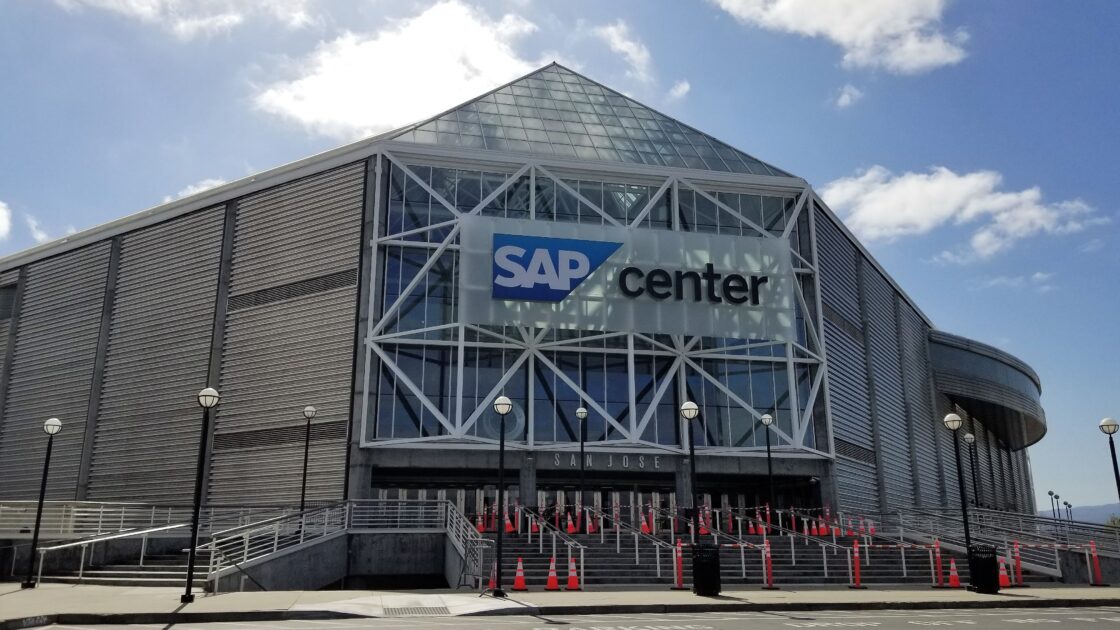
San Jose Sharks president Jonathan Becher spoke to members of the Bay Area media today.
He touched on a wide range of topics, from the Sharks’ low attendance (and why he’s optimistic that it’ll go up), why San Jose won’t go into a re-build, how they’re hoping to attract more fans next year, what they’re updating at SAP Center, Doug Wilson’s health, and how much money the San Jose Sharks will lose this year.
Here’s the full transcript.
Jonathan Becher on the San Jose Sharks’ low attendance:
The reality is, the pandemic is dramatically impacting people coming back to events. I look at all the NHL reports, all three California teams are seeing a year-over-year decrease somewhere between 20 and 25%. They’re actually quite a few teams outside of California that’s seeing a 10% decrease. And there’s one team that’s seeing a 40% decrease.
You know, we’ve done fan surveys, both for shorts, and actually for concerts as well. I think some of you have done your own surveys as well. I’ve seen those on the web.
The dominant reason is COVID. Some people are not comfortable coming back to mega-events. Frankly, some people are comfortable, but they don’t want to deal with vax, boosters, masks, etc.
Here in Silicon Valley, remote work is a huge deal. And there are a lot of companies that won’t let their employees come to big events, they can’t host customers, etc., which is a big part of our fan base historically.
People have moved away, at least temporarily, from the Bay Area.
But by far the biggest issue affecting attendance is the mandates. NHL, county, city. Feels like we have more mandates than any other venue in the United States.
Of course team performance is going to be a little bit of a factor as well, but it’s always way down on the survey after COVID.
I’ll give you some informal feedback, which is if you look, pre-Omicron, our first few home games were all above 14 and 15,000, sort of normal attendance. And I can break down the details of that, since Omicron, that’s when we’ve seen the biggest dip.
It’s hard for me to say we’re in a post-Omicron world, although it’s starting to feel that way. And Saturday’s game, when I looked earlier this morning was nearing 15,000 people in attendance. My sense is we will break 15,000 for the first time since the first couple of games in the year. So that’s evidence that people will come back as restrictions ease and as they feel safer.
Becher, on the Sharks’ lack of attendance potentially affecting team decisions:
The short answer is no, but let me elaborate on that a little bit. The owner [Hasso Plattner] has had a long history of spending to the cap. The best way to get a winning team is to continue to spend to the cap. So that’s been our history, and I don’t see any environment under which that would change.
So no, and especially since we already started to see attendance starting to build for the last month or so of the regular season. And there are already some good signs for next year, [if we don’t have] another [COVID] wave.
Becher, on what other areas COVID has affected in the organization:
The ever-changing rules and regulations of who can attend and what it takes to get them in. Do you need to be boosted, if you’re booster eligible or not booster eligible?
That’s been operationally a drain for us, we’ve totally understood why it’s critical to keep the citizens of Silicon Valley safe. And we’ve worked hard to do that, have invested significantly, for example, in things like the Clear health pass, so there are no fake vaccine passports. But this has been a strain for us as we try to hire and train a lot of new people to keep up with these ever-changing regulations. So we’d love some consistency and normalcy as well.
That doesn’t mean going back to 2019. But repeatability and less difference between local county state and federal rules would make our lives much simpler.
Becher, on future promotions and other incentives to increase attendance:
So there are tons of things we can and have done. One of our most popular promotions we’ve done in the past, which we’ve done again this year, is we pay the fees — especially in these days, when the box office isn’t open for a long time. So we have a series of flash sales – we’re in the middle of one going on right now – where we’re picking up the fees and paying them so that the consumer doesn’t have to. We’ve actually already noticed a larger number of tickets sold in the last couple of days.
Looking forward to next season, we’ll announce a number of changes for next season’s membership, because season ticket memberships are always a large fraction of the number of people that are in the arena. And frankly, it’s the largest fractions of no-shows as well, where we’ve already been pre-paid, but people don’t show up. So in a weird way, still not good for the product.
We’ve reduced the price of every seat in the building for membership, on average. It varies by section and it varies by location, but on average every seat is down 5%. So we had a bunch of other offers up our sleeve as well but essentially picking up the fees and reducing prices should, if the price is a barrier for some people, help with attendance as well.
A couple of new things that are coming as well is if you’re subscribed to a subscription service, like Netflix or something, we’re offering a Netflix-like membership next year also where you can turn it on and off by the month. So maybe you want to come [a lot] in December, but not at all in October, you can subscribe by the month. We tested it out last season and it was quite popular. So we’re going to bring it back next year for every month as well.
We’re actually coming out with a quick in-bowl upgrade as well. So if you buy in the upper bowl, you could take a chance that our lower bowl seat might be available last minute and get it at a ‘bargain price’ as well.
We’re using something called Teal Tokens as an incentive, basically, a reward program, where anything you buy in the building merchandise, food, and beverage tickets, etc., you get 3% cashback and you can earn Teal Tokens in lots of different ways. Ultimately, those Teal Tokens will be available for online merchandising and probably over in Sharks Ice as well. So there’s plenty of these kinds of new ideas that are coming to encourage attendance.
Becher explains why current memberships are far below the 14K from about a decade ago:
Membership has changed a ton compared to 12 years ago.
So one phrase that you’ll hear in the industry is called FSCS, or full season equivalence. So that’s fulls plus halves, plus partials plus suite leases. So for example, halves, (half-season), across hockey and other sports as well are one of the most popular products. Now, instead of signing up for every home game, plus three or four, depending on the preseason, you only sign up for half of those, those have grown – and I forget the exact number, but 1,000%, since they were announced only a few years ago, they wouldn’t have been in the inventory if you go back a dozen years ago, because it wasn’t offered. So before the pandemic, we were sitting at about 11,000 or so, pre-sold tickets is maybe the way to think about it. FSCS (full, halves, partials, suite leases), which has been a pretty consistent range, which goes back to 2014-2015.
We’re down from that 11,000 number to a number that’s about nine and a half thousand right now. In an average year, about 85% or so across sports, renew their season tickets, and that’s pretty normal in hockey and other sports as well. And then you close that gap of trying to sell some renew, which is if you do 15%, then you get back to break-even. So we’re still renewing roughly 85%, sometimes a little bit lower at the low 80s. But the renews, during the pandemic didn’t come in at nearly the rate, largely because people didn’t want to sign up for three-year memberships.
Instead, we typically had them renew at about the 5% rate. So you’ll bleed whatever that is and do the math, about 10% or so for the last two years. So that brings us down to the nine and a half as the pre-sold from there. And then on top of that, you build in what is often called affinity groups or group outings or corporates. Our largest one, of course, is Los Tiburones. But the average night there are about 1000 people that do that. And then you sell tickets just to a game. Those are called IGs and industry individual games, that’s usually about 2,000 a night. And then there are 500 or so miscellaneous player tickets, off-ice officials, visiting teams, 100 or so comps, etc. And that’s how you build out what pre-pandemic was about 14 or 15,000 people in the building for a normal game. A little higher on the weekend. A little less on a Tuesday.
Becher, on SAP Center’s age and upcoming updates to it:
If you pick chronologically, I think we are the third-oldest building in the league, although we opened like 31 days before Anaheim, and in fact, there are seven buildings that opened all within 12 to 15 months of each other…But we have a very different philosophy here than pretty much every other building that I’m aware of, which is, we do significant upgrades every year, including the year after the building opened. On average, we spend somewhere between five and 10 million on arena upgrades every summer, when there are still events in the building, but without hockey, it’s not quite as busy as it is during the regular year.
Over the last couple of years, in the pandemic, we did that as well. Many people noticed we rebuilt the ice plant, we broke into the foundation of the building, which was 33 years old and replaced all the water pipes and the ice floor as well. We’ve switched out the escalators, we made the actual concrete because earthquakes codes have changed in the last 30 years as well.
So I don’t think we’ve ever announced the exact number we spent — significantly more improving the building than it cost the building to be built 30 years ago, and we’re going to continue that process. If you’ve been in the building lately, we’ve changed some of the stands so that it’s more self-service. One of the most popular things on the concourse right now is called the Market where instead of having to wait in line to buy something, you can self-service, scan it yourself and walk out. Even simpler if you have the app itself.
We’re going to do a lot more investment this summer for more self-service areas as well. It’s faster, less reliant on part-time help that we can’t get — one of those stands is now doing 5x this year than it did last year as well, etc.
I talked about the digital wallet, we went cashless, we built an environment to create digital cards for people as well, we built the rewards program, you’re gonna see a lot more investment in Teal Tokens going forward as well. If you saw our announcement on crypto, you might have some essence of where that’s going.
I’ll go ahead and make an announcement, which is we are going to replace the center hung monitor in the bowl over the summer, to make it significantly bigger and brighter and higher pixel ratio. The overweight is simply thinking about it as it’ll have to multiply the surface area than the current one has. For those of you who like numbers, it should be basically 23 feet tall, and 164 feet of visible area. And it goes from 10-millimeter resolution down to 5.9-millimeter resolution. That’s a nonlinear scale. So it’s basically twice the density as well. I have a lot of other changes as well, including an underside video that you can see as well. But that’ll be a big visible thing that people see. So there is a scoop for you.
We are prepared and the owner is prepared to invest significantly more than we have already. You know, 10x, those kinds of numbers. A Madison Square Garden-style renovation if you want a visual metaphor in the coming years, once we’ve got visibility from the city about what life looks like past 2040.
I’ve been very transparent, we would love to stay here past 2040. Right now, we don’t have that option. We have to give three years’ notice and then we can get out. We’d rather not do that, of course, but with the five large transformational projects happening outside our door…there’s no plan despite us talking about it for several years on construction mitigation for those five plans. That’s five times projects which might literally make the arena inaccessible for a decade or more. I’m not talking about parking, I’m talking about literally no way to get to the arena, then we can’t spend the money. We shouldn’t spend the money until we have a little more surety from the city. That’s justifiable. But yes, the investment we make will dramatically expand the lifetime of this building.
Becher, on San Jose Sharks owner Hasso Plattner’s reaction to the low attendance:
He’d like more fans in the building as well. But he definitely understands this is primarily COVID-related. Hasso is really good at differentiating between one-time effects and systemic ones — when it’s one time and they’re mostly out of our control — and he’s quite understanding. If it’s self-inflicted, then he’s less understanding. And if they’re ones that need systematic improvements, that’s where he likes to put our energy. I have that conversation with him quite frequently.
Becher, on the crowd increasing this season:
So let’s just say the opening night was above 15,000. I forget the exact number. The next two games were in the 14 level. And the game against Boston this Saturday, when I looked this morning, total tickets issued are just shy of 15,000. If past sales patterns hold that will break 15,000.
What I don’t know is what the no-show rate will be. We varied between 10% no-shows on the low end to 20 to 25%, which was quite normal during the height of Omicron. One game, I think it was two weeks ago, we had 35% no-show. So tickets issued on Saturday, we’ll almost certainly break 15,000 or be really close. What I can’t tell you is how much the no-show rate will be.
Becher, on why the Golden State Warriors can still sell out the Chase Center, while the Sharks can’t sell out SAP Center:
So a couple of things. One is even before the recent lifting of restrictions, we had more severe restrictions than they did. It’s complicated.
We tried to make it simpler, but we had Santa Clara County mandates and City of San Jose mandates. And those are different. And because of the way this works, we have to take the most restricted from each of them. So for example, we didn’t have a testing option. Until recently, they’ve had a testing option all along, which gets another group of people in. So I do talk to the Warriors on a regular basis. Can’t say quite monthly, but close to that as well. And the drive to get actual people in becomes much more difficult when you have to Vax boost test, mask etc. So I do think it’s primarily that and the fan surveys do say that.
Do I believe that there is a segment of the Sharks’ fan base that won’t come back into the building while there’s a vaccine mandate? Yes. That is definitely what we’ve seen that consistently in our survey fan reports. It’s not huge, but it’s there.
Becher, on the communication between the San Jose Sharks, Google, BART, and the city of San Jose on ongoing projects in proximity to the SAP Center:
I’m happy with the level of communication that’s happened in the last year, yes, I would say as an extended team, many of them with me personally, we have two or three conversations per month. With either city, the city, Google, BART, sometimes high-speed rail or Caltrain because those are all part of the projects as well.
Those conversations are regular, they’re cordial. They’re extraordinarily detailed. I think it would be a stretch to say that we made much progress since I said we had a sort of stand-down agreement with them. In reality, there’s been very little change in the landscape in the last six to nine months or so. And my level of concern that we’re reaching a conclusion that we need has increased of late, not decreased.
That coupled with what many of you may have read, the BART timeline seems to be extended a few years so that the BART won’t open. I don’t want to pick a date, but for many years after originally expected, which means the construction and cluster around us will be even longer than we originally anticipated.
So more than anything else, a mitigation plan, a construction mitigation plan. So all these projects don’t operate at the exact same time and they don’t shut down all the streets at the same time and hundreds of dump trucks aren’t going all at the same time. I’m less confident now than I was then about that…It’s been postponed multiple times, it should have already started by now. The latest indication I have is likely construction could start in the first half of 2023 meeting next year. But the bigger disruption would happen in 2024.
Becher, on Plattner’s support of the team’s current competitive trajectory:
It’s hard for me to speak on behalf of Hasso, other than he is really supportive of the team and will continue to spend to the cap to get us back in the playoffs if we don’t make it this year. So yes, he likes the direction we’re headed on. Yes, he watches all the young players, including those that are back in Europe, and that factors in his decision. Would he like to see us win more games? Now? Of course, he would. But does he feel like we’re headed in that direction? Yes. Would he like us to move in that direction more quickly? Certainly. But at least in my experience with him, as you may know, I worked with him before I joined the Sharks as well, he’s a pretty patient guy.
Becher, on the possibility of a return to the Top of the Tank promotion:
We won’t bring back exactly the Top of the Tank promotion the way it is. But yes, we plan to bring back something which will be named something else, which will be a stripped-down membership without all the other benefits at a very low and affordable price. So yes, but with a change based on feedback from members and non-members that wanted something slightly different.
Becher, on season tickets deferments:
We deferred anybody that wanted to throw out the last season to this season. And I don’t remember the exact numbers, many of those that deferred had already paid. Some of them are showing up this year. Some are not. We have a large fraction of our full-season tickets, but not our halves and partials on a three-year plan. Some of those are expiring on the three-year plan right now. So we’re renewing them for another three years. Others don’t expire for next year. So the problem is there are so many different buckets of those. It’s hard to give it a generic answer other than, most people that deferred are back, but not all.
Becher, regarding the potential decision to release the A, B and C parking lots to Google:
We have not agreed to release A, B, and C lots. We don’t have an agreement yet, basically.
Becher, on city and county updates regarding mask mandates:
We talk to them quite frequently. I would love to say it’s imminent, but I’m not sure I could say that. But as a reminder, even if the county lifted their requirements, there are still city requirements as well. So we need both the city and the county to release the requirements to be equal to other venues like the Chase Center.
Becher, on possible updates to the SAP Center sound system:
That is something we’re investigating. I don’t have anything to announce. For every person that complains it’s too loud, there are other people that complain they can’t hear it. So I don’t know, what some people have proposed is that’s because there is an uneven distribution of people in the building. We’re not entirely sure that’s really true, but it is something we’re researching.
Becher, on the possibility of Doug Wilson rebuilding the San Jose Sharks:
Let’s call it ‘our’ plan rather than one person’s plan.
Because, even though Doug is out for medical, it’s always been our collective management plan, including Hasso. It’s not just done by himself. Secondarily, I think I’ve said in other forums, and I’ll reinforce it, we are highly unlikely — and I never say never — highly unlikely to go through a proactive rebuild. It seems difficult to ask people to sign up for three or five years worth of full or partial season tickets and tell them we’re intentionally not going to be good for those three or five years. Having said that, we are going to get younger, we are going to get faster, we are going to make some changes. And that’s the part we’re going to market to fans and focus on.
Becher, on if he hears the fans who want a rebuild and why he doesn’t think the Sharks can do it in this market:
We do hear the minority [fans who would be supportive of a rebuild], but it’s hard to gauge exactly how big they are, meaning how many of them there are, but they are quite vocal. They do manage to get ahold of my e-mail and send me periodic e-mails as well about rebuilding.
I think the reality is that in our market, in particular Northern California, there’s a fight for a share of entertainment dollars, not just sports, but all of entertainment whatsoever. And if your product is not engaging, people don’t interact with it frequently. And I think we’ve seen that from time to time. You can ask any of the professional sports teams in Northern California and beyond as well. Does attendance correlate with how good your team is? And almost invariably, every one of them will tell you? Yes. Having said that, it’s also just sports is about winning. I know other teams and other markets have intentionally not won. That’s not Hasso’s style. It’s not my style, either. We want to win every single year.
Another way to say that, is saying if you think that the only reason to come to a game is purely to see a win and not for the entertainment factor as well, then that would be the answer. Personally, I believe that modern sports are yes, win as often as you can, but it’s also the experience
Becher, on how much money that the San Jose Sharks will lose this year:
We’ve always been a break-even sort of team or a small loss. And even with that loss, we always spent to the cap. The pandemic dramatically hit our finances, not just for people in the building, but other sources of revenue as well as merchandise sales. I think at some point, during the pandemic, I said cumulative losses have exceeded $100 million. So the number is clearly north of that now, and while I do believe it started to settle down and turn around, those losses are still disproportionately large compared to pre-pandemic.
Will we get back to pre-pandemic losses or break-evenish next year? It depends – we’ll get close, probably we’ll get it, by the end of the year, but I don’t know if we’ll be there at the beginning of the year.
Becher on the new San Jose Barracuda arena:
We’re now on budget and on schedule. So we still will open in August, we’ll have an official opening ceremony, and the Rookie Tournament, I think it’s the first real event that will be in that building. If you haven’t had a tour lately, it’s shaping up to be world-class. I’m biased. I think it’ll be the best building in the AHL, but draw your own conclusion, when you actually go as well.
We do envision it as a multi-purpose arena, the same way that SAP Center is a multi-purpose arena. We won’t book 180 events in year one, like we average 160 to 180 events here. But we are definitely going to have other concerts, family events, e-gaming as a possibility in that arena as well. We have talked to other pro and semi-pro and college teams about playing sports in that building, hockey, and non-hockey as well. Overall, we have no deal to announce [but] there are already a number of national government governing body events that didn’t feel like they could fill a 17,000 seat arena that feel comfortable in a 4 to 4,500 seat arena.
I think in a couple of years after it opens, it usually takes two or three, maybe four years [for the event number to] settle down. We should average 120 to 130 events per year in that building [eventually].
Becher, on the Barracuda’s low attendance:
We’ve gone on sale for pre-opening foundation members and tickets partners as well, interest seems to be pretty strong, we’re operating pretty much on schedule for that as well.
The cost to open the SAP Center is significantly higher than the cost to open a smaller arena like that. Pretty soon we ought to be able to announce the name of that new arena as well, it will have a brand associated with it, and should be announced in the coming weeks or maybe months.
I expect a regular venue of 3,000 plus and sold-out on some nights as well. Like here, weekends will be more popular than weekdays. Back before the pandemic, the number-one reason people gave us that they wouldn’t come on Tuesday, as opposed to Saturday, was not an opponent, which is what we like to say it is, but rather traffic. Traffic is starting to return to pre-pandemic norms. If you’ve been out during rush hour, I expect it will get back there by next season.
People sometimes think twice about showing up on a Tuesday [versus] a Saturday. Traffic’s a lot easier.
Becher, on how often he speaks to Doug Wilson:
Between Joe [Will] and I, we talk with him relatively regularly. He’s asked us to keep his situation private. We respect his privacy, but he’s doing reasonably well. But there’s no timetable for when he might return at this point.
Becher, on any possible changes to the internal structure of the San Jose Sharks:
We will certainly entertain changes to our structure over time, but nothing’s particularly imminent.
But in general, we are not hierarchical guys, we’re pretty much a fan of flat structures. Even just on the business side, I have fewer VPs and SVPs and EVPs and C levels, than I won’t say any other sports team, because I can’t say that — but in general, we have a lot less than others. So I don’t imagine us adding hierarchy for the sake of hierarchy. But we might create new roles when we find new ways.
Becher, on current employment levels within the team and SAP Center:
We’re not quite at pre-pandemic levels.
Last I looked, which was probably last week, we’re at 80ish percent, I think, trending towards 90% by the end of this month. So we will get there certainly by the end of the season, hopefully sooner before that, but we’re almost there. It’s been tough though, retraining the entire core, which we almost have, takes a lot of work to get to our standards. And, you have to work for 5, 6, 7, 8 games before we know we’re the right place for you and you’re the right person for us.
Just because we signed somebody up doesn’t mean they stay forever either.