
 Sheng Peng
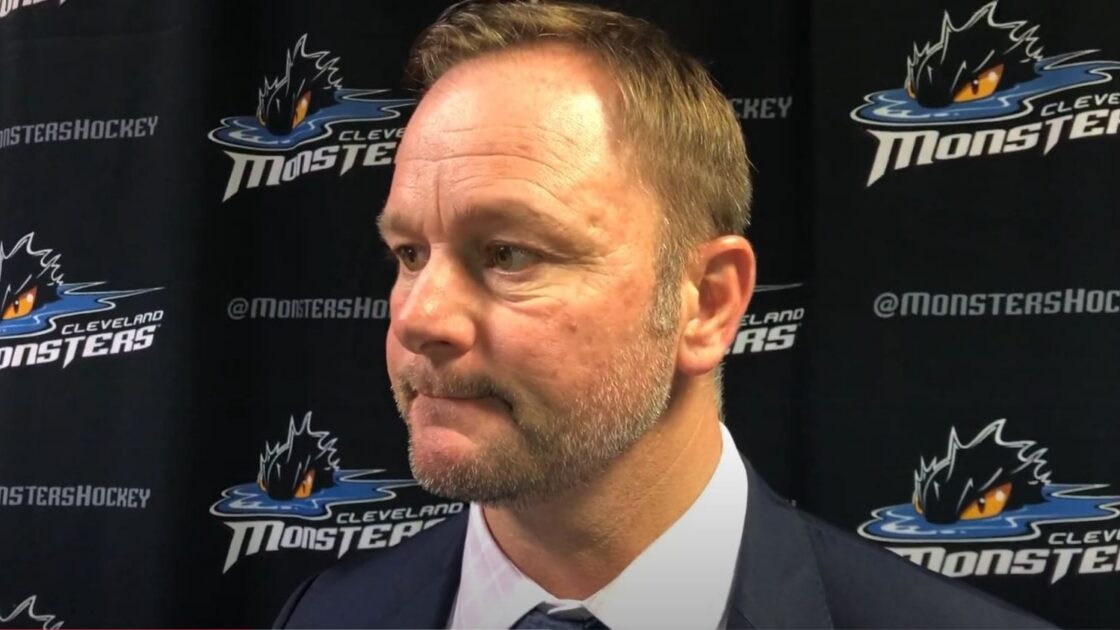
“I probably wouldn’t be one of the guys that people [think would be into] analytics.”
John Madden — three-time Stanley Cup champion and 2001 Selke Trophy winner — says he didn’t jump into analytics until a few years ago. But now?
“I love using them.”
San Jose Hockey Now caught up last week with the new San Jose Sharks assistant coach for a fun, fascinating interview. Madden, from his Kentucky home, answered these questions and more: Has the San Jose Sharks coaching staff found a defensive scheme that fits their personnel? What did Madden, who’s coaching the forwards and running the penalty kill, learn from closely watching the 2020 Lightning? How does he apply analytics to the penalty kill?
Sheng Peng: How did you end up in Kentucky as your place of residence? It’s not exactly a hockey hotbed.
John Madden: We were in Florida for a while after I was playing there and working there. We just moved here in January. My daughter [Reese] is in show jumping horses. We’re right in the smack dab middle of Kentucky, 10 minutes from the horse park, the show grounds, it’s just horse country, so it makes sense to be here.
SP: Let’s start off with a fun one. Travis Zajac said you used to cut your toenails and leave the scraps on Colin White’s stall to mess with him.
JM: Colin White and I are really good friends. I don’t wanna say too much, but he doesn’t like feet at all. So I put them on a piece of tape and and stuck them on his name plate and he’d come back and freak out. It was kind of like a little joke to keep the dressing room loose.
SP: Speaking of your playing days, you played a lot against Bob Boughner. What memories do you have of playing against him?
JM: I just remember him being hard-nosed, tough in terms of hard to play against. Physical, going the extra mile and doing all the little things right.
He wasn’t the guy you want to play against every night, that’s for sure.
SP: How did it come together that you joined his staff? As far as I know, you don’t have a long-standing relationship with Bob or anything.
JM: You’re right. I’ve never even had a cup of coffee with Bob. He was part of the PA, so we encountered each other there from time to time, but never really had a conversation with him or anything.
Somehow, my name got filtered to him, I guess. And we just started conversations that took three to four weeks talking on the phone. Finally, we were able to get together, share a cup of coffee, have some lunch, and just get to know each other.
We were on the same page about a lot of things.
SP: Why do you think you stood out among the many candidates?
JM: If I had to take a guess, we aligned with a lot of our vision, from everything from the locker room to how to develop a player to defensive zone coverage to PK.
There are some other things that maybe I brought to the table that Bob didn’t have already on the staff because he already had hired Rocky. A faceoff guy. A guy who killed penalties in the league.
SP: Can you elaborate a little bit more about what you guys aligned on?
JM: In terms of developing a player, I had the opportunity to be in the American Hockey League for quite a while. For three years. And obviously with my son [Tyler] coming up. Kids are a little different than what we were used to growing up with.
We just talked about repetition. Just giving kids opportunities, you know, confidence and things like that.
Those are things I’ve seen with my son [Tyler], the more opportunity, the more confidence.
As far as the penalty kill goes, we just went through systematic things. Analytic things.
We went through D-zone coverage. Teams out there play different systems. And I think the one big thing is you can implement a system, but if it doesn’t fit your personnel, it’s not gonna work. That was one of the big things that I think that we hit it off on.
Dallas is a certain way. Tampa plays a certain way, We’re looking for something more specific to what we have on our team.
SP: Is it fair to say that you guys have found the defensive system that you think will work with the San Jose Sharks?
JM: Yeah. I think that we’ve nailed it. [Bob and Rocky] had done much of the legwork
There’s going to be slight adjustments as we move forward, just like every other team out there. But I just thought that it fit.
SP: In your press conference a couple months ago, you talked about analytics and the PK. I assume that when you were playing, there wasn’t much in terms of analytics? (San Jose Hockey Now note: Madden retired in 2012)
JM: There wasn’t analytics, that’s for sure. And there definitely wasn’t much video until later on in my career. Maybe 2008, 2009, or maybe 2010.
But with all this, they’re all aids, they’re all tools to get your answers quicker. You can use analytics to teach and make people understand.
I wouldn’t say someone’s eyes are the final say, I wouldn’t say that analytics are the final say. I think there’s a happy medium between everything that you can do.
I love using them. I probably wouldn’t be one of the guys that people [think would be into] analytics. But I’ve had the opportunity to learn about them, how you can use them, it’s been great for me.
SP: Rocky Thompson spoke of learning about analytics from Tyler Dellow as an assistant coach in Edmonton. Did you have somebody like that to show you the ropes?
JM: Yeah, we had a guy like that in Cleveland, Austin Powell, he works with the Florida Panthers right now as their video coach. He graduated from Penn, never played hockey, so his ideas and my ideas, we sat down a lot and talked.
It’s amazing how he could come to the same answer relatively quickly as I would after watching two hours of video. I was like, wow, that’s pretty impressive. Can you teach me more? So we spent a lot of time together, just talking about it.
That’s when I really started to get into it because I was able to sit there and really learn about it rather than just read about it on Twitter or some website.
SP: From your perspective, as somebody who killed penalties successfully for so long, how have analytics changed the PK?
JM: Tendencies are the best. You can pick them apart real quick. You’re like, most of the goals come from here. Why? Okay, how do we stop that?
Who handles the puck most? Who’s the biggest shooter on team? Those are things that you could probably pick up easily if you’re watching video.
But it gets your answers quicker with analytics. You know exactly what you’re looking for on video.
SP: Your last year in Cleveland in 2018-19, you made the playoffs on the last day, then upset the No. 1 seed in the first round. But there was a mutual parting of ways after that. What happened?
JM: Nothing really happened. I was looking to get to the NHL. I had been away from family, they were living in Florida for three years. I hadn’t seen my son play a hockey game in college except once.
We just needed a break, in terms of putting our life back together. My daughter had just turned 18.
Turns out, when COVID hit, we spent a lot more time together than we ever thought we would. (laughs)
It’s been good. Ty came back from college in March. We got March, April, May, and June together before he went off training. Those are months we haven’t had in a long time. From prep school in ninth grade in Avon, which I didn’t get to see a lot of because I was in Florida, it’s just been a long go.
As soon as I started coaching, it just seemed like we were always scattered and all over the place between my daughter’s riding and my son always going off to train. We just didn’t have that family time. And we just thought it was time to get it all together.
SP: That’s awesome. One of the things that I was curious about then, how have you been getting better as a coach in the last year?
JM: When this season started, I just found myself watching four or five hockey games, flipping back and forth. Just watching a lot more and learning more about players in the league that maybe went under the radar in my eyes.
It’s been nice to sit back and watch and learn. You watch Tampa, you watch different teams that are playing very well. And what are they doing?
You pick up on things and make little notes in your head. You steal a little bit some of the schemes or plays they’re doing.
SP: Can you speak to maybe a couple of things that you picked up from watching all this hockey?
JM: Tampa was a team that I watched closely because of the playoffs. I just love how active their D are in the offensive zone. I also liked the way their forwards cover for them, which allows them to be active.
When they get in the zone, it’s not just throw pucks to the net. There’s a lot of rolling. There’s a lot of high rolls. There’s a lot of three high. There’s a lot of weak side. And I love the way that they use the royal road. A lot of their passes will go across there, which makes them a high-scoring team. It was just fun to watch.
Those are things that my son and I watched over the playoffs and that was pretty cool. It helps me too to bounce things off him. What has he learned at Northeastern?
SP: You learned, as a player, to take great pride in playing defense. You learned to love to play defense. As a coach, how do you motivate guys to learn to love playing defense?
JM: [The thinking is] you’re either an offensive player or you’re a defensive player, correct? I think the game has changed so much that you don’t have that luxury anymore. If you’re a defensive player, you still have to provide offense. And when you’re an offensive player, you still have to provide defense.
I think the biggest key is showing kids who have scored 100 points in the OHL, 45 or 50 points in college — so we’re talking about the elite players — if you show them how to play better defense, your numbers are just going to go up on offense because you’ll have the puck more.
The one thing I always tell my son is who knows what type of role you’re gonna play in the NHL? You never know — you have to pick up every little thing in order to make the NHL.
A lot of guys out there put 70 points up in the AHL, but they find themselves in a role where they’re maybe not on the top-six [of an NHL team]. So you gotta go both ways — I think that’s important for every player.
If you look around, there’s not too many players out there where you say they really don’t play defense. Everybody’s got too.
SP: And last one — just back to your playing days and nothing to do with cutting your toenails — do you have any memories of playing the San Jose Sharks? Obviously, you were in the Eastern Conference for most of your career, but you did play them in one important series in the 2010 Western Conference Finals when you were with Chicago.
JM: I just remember — I was talking to Bob about it — I just remember going into the Shark Tank and finding it very difficult to play there. It’s hard to play in that building.
I did score my first point against the Sharks. I think it was a power play assist to Brian Rolston. (SJHN note: Madden scored his first NHL point on January 18, 1999 at San Jose Arena)
It just always felt that way, it was a hard building to play in. It just felt, for whatever reason, I didn’t have very many good games in that building.
I’m sure if you ask any former NHL player if they have a building that they least like playing in, that was probably a top-five for me.
SP: Well, now I gotta look up your stats in San Jose. Hopefully, they aren’t too embarrassing, man. (SJHN note: They aren’t — Madden scored two goals and an assist in eight career regular season games in San Jose)
JM: I think I actually scored on my own net in San Jose when I was with Chicago. I’m pretty sure. I went to bat the puck out of the air, it was just a messed-up situation. (laughs)
SP: It wasn’t your fault, it was the arena’s fault.
JM: Yeah, yeah, yeah. (laughs)