
 Sheng Peng

In 2017-18 and 2018-19, John MacLean led the Arizona Coyotes power play to 26th-place finishes in both seasons.
That’s the man running the San Jose Sharks power play now?
But ex-Coyotes video coach Steve Peters of PHNX Sports, who worked with MacLean on Rick Tocchet’s staff, doesn’t think you should judge a book by its cover.
“The power play is really dependent on the personnel that you can put on the ice. But without that Alexander Ovechkin one-timer from the top of the circle and having a secondary threat somewhere else? Unfortunately, during those years, the Coyotes didn’t have that weapon,” Peters shared. “It wasn’t a coaching issue, it was a personnel issue more than anything. I don’t want to sound like I’m disparaging the players on that team. It’s just, you need that danger. Someone on the ice to open up somebody else.
“As Phil Kessel came, now you’ve got a threat. Now you move Jacob Chychrun to the top. And now he’s a threat.”
In 2019-20 — Kessel’s first season in the desert — Arizona’s PP rose to 18th. Last year — Chychrun’s breakout campaign — the Coyotes’ man advantage crossed into above-average, to 13th in the NHL.
Another way to underscore Peters’s point? To start the 2018-19 season, Arizona trotted out Oliver Ekman-Larsson, Richard Panik, Vinnie Hinostroza, Clayton Keller, and Derek Stepan as their top power play unit. By the end of the year, Ekman-Larsson and Keller were joined by 20-year-old Chychrun, eternal reclamation project Alex Galchenyuk, and rookie Conor Garland.
That season, the Coyotes were paced by Galchenyuk and Brad Richardson with just 19 goals. They were 27th in the league in scoring.
MacLean wasn’t working with the Wayne Gretzky-era Edmonton Oilers, to say the least.
It’s worth noting too that the San Jose Sharks PP bears zero resemblance to Gretzky’s Oilers — Erik Karlsson, Brent Burns, and company finished 29th in the NHL last year.
But maybe a change of philosophy will help San Jose’s power play? So what is MacLean’s philosophy?
Peters predicts what to expect from the Sharks man advantage under MacLean:
“You look at John MacLean as a player. Offensive threat from all over the ice, can shoot to score, just had that nose for the net.”
MacLean racked up 413 goals over 18 years in New Jersey, San Jose, with the New York Rangers, and Dallas. He won the Stanley Cup in 1995.
“And I think he tries to bring that same concept or element to the power play, it’s going to be simplified. It’s going to be easy,” Peters said. “If you have a chance to shoot, shoot, it’s not going to be let’s look for the perfect play.”
MacLean was third in the league with 322 shots in 1989-90.
“That’s a big thing that players look at, if you’ve won and you scored goals, yeah, I’ll listen,” Peters offered. “That will help him right away inside the room with the players.”
Considering MacLean was hired two weeks before training camp — because of the surprise resignation of Rocky Thompson — this instant respect could help?
However, MacLean wasn’t able to imprint a shot mentality onto the Arizona power play. Per Natural Stat Trick, they were second-to-last in the NHL in 5-on-4 Shots Per 60 in 2018-19.
Regardless, Peters believes that will be MacLean’s mentality in San Jose: “I don’t think you’re gonna look for really fancy plays or backdoor tap-ins. It’s going to be quantity. Get the shot, get the good look, get the puck at the net.”
Peters also noted that MacLean is flexible with how the power play sets up: “[It’s not] this is our setup, make sure we get in this setup. Everybody has to know what everybody’s job is because you end up in all areas of the ice.”
That’s what I got too from watching MacLean’s 2018-19 Coyotes PP: I saw Chychrun, for example, playing net front, high slot, and flank on the man advantage. The only consistent was Ekman-Larsson up top.
Maybe MacLean will use Burns like he used Chychrun?
Here’s one area where MacLean’s power play might look clearly different than Thompson’s.
“One thing John does, especially on the breakouts and entries, he simplifies things,” Peters said. “You’re not going to see a San Jose Sharks team with five, six, or seven different power play breakouts. There’ll be two or three.”
Thompson is known to be creative with his breakouts — the San Jose Sharks tried double-drop passes, had three trailers coming from behind the puck carrier, and emphasized quick strike attacks, among more unusual approaches.
On the breakout, MacLean’s direction might more resemble San Jose’s power play coach before Rocky Thompson, Steve Spott. Spott usually employed two breakouts, the single drop pass (with two trailing forwards) or the “five man” swing.

I saw a lot of similar Ekman-Larsson drop passes in my review of the Yotes PP under MacLean.
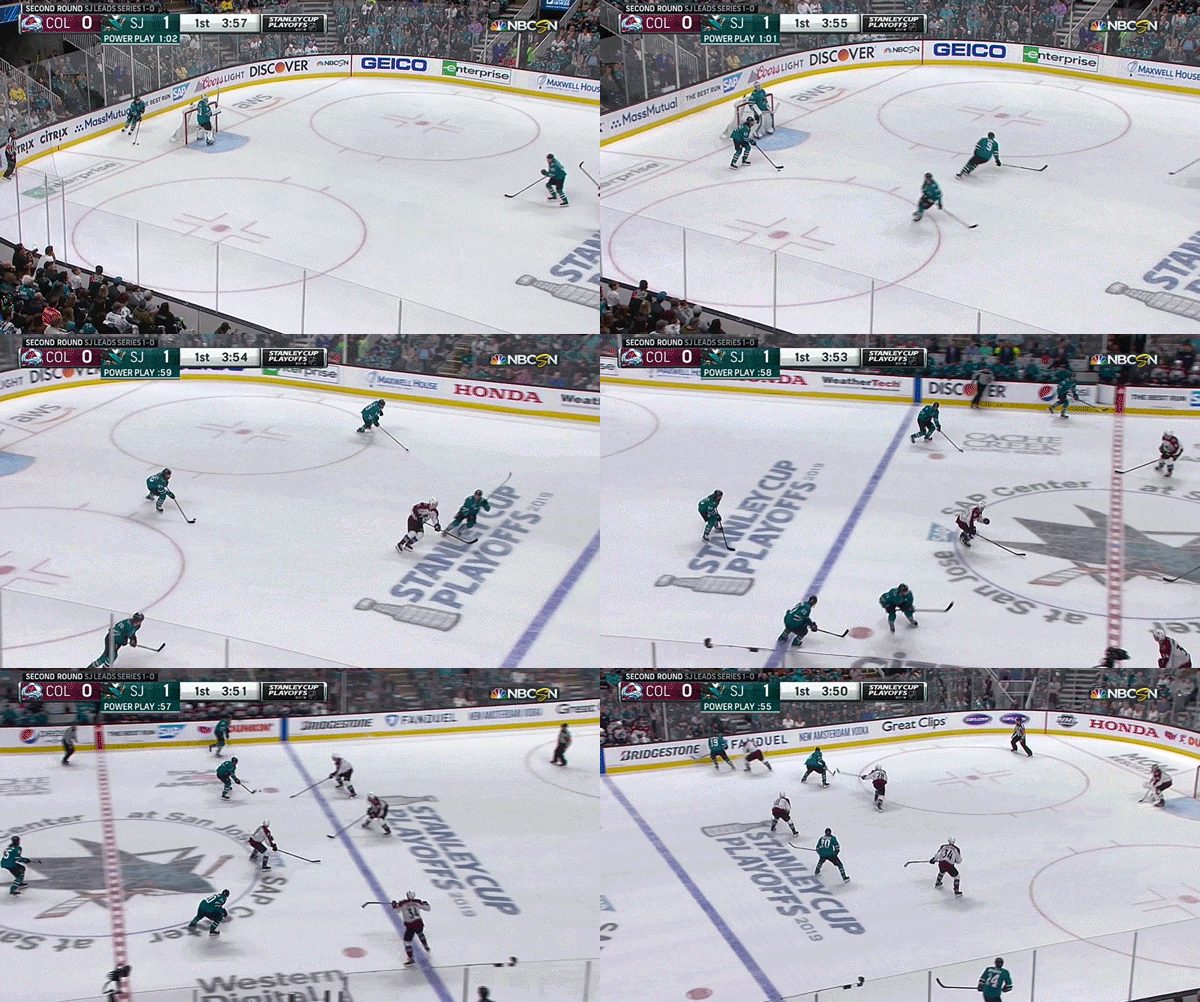
While MacLean may not use these exact breakouts, there’s a common theme with everything that Peters said about his former colleague. Easy does it?
“Make it more simple,” Peters summarized. “I think that’s the direction that John’s gonna try to take it.”
Thanks to Craig Morgan for his help with this story.