
 Sheng Peng

The San Jose Sharks have run two common power play breakouts over the last two years.
There’s the two-man drop pass:

Usually, it’s Erik Karlsson (65) as the quarterback, who drops the puck back to the two forwards coming from behind with speed. The forward who receives the puck usually passes.
Then there’s the “five man” swing:
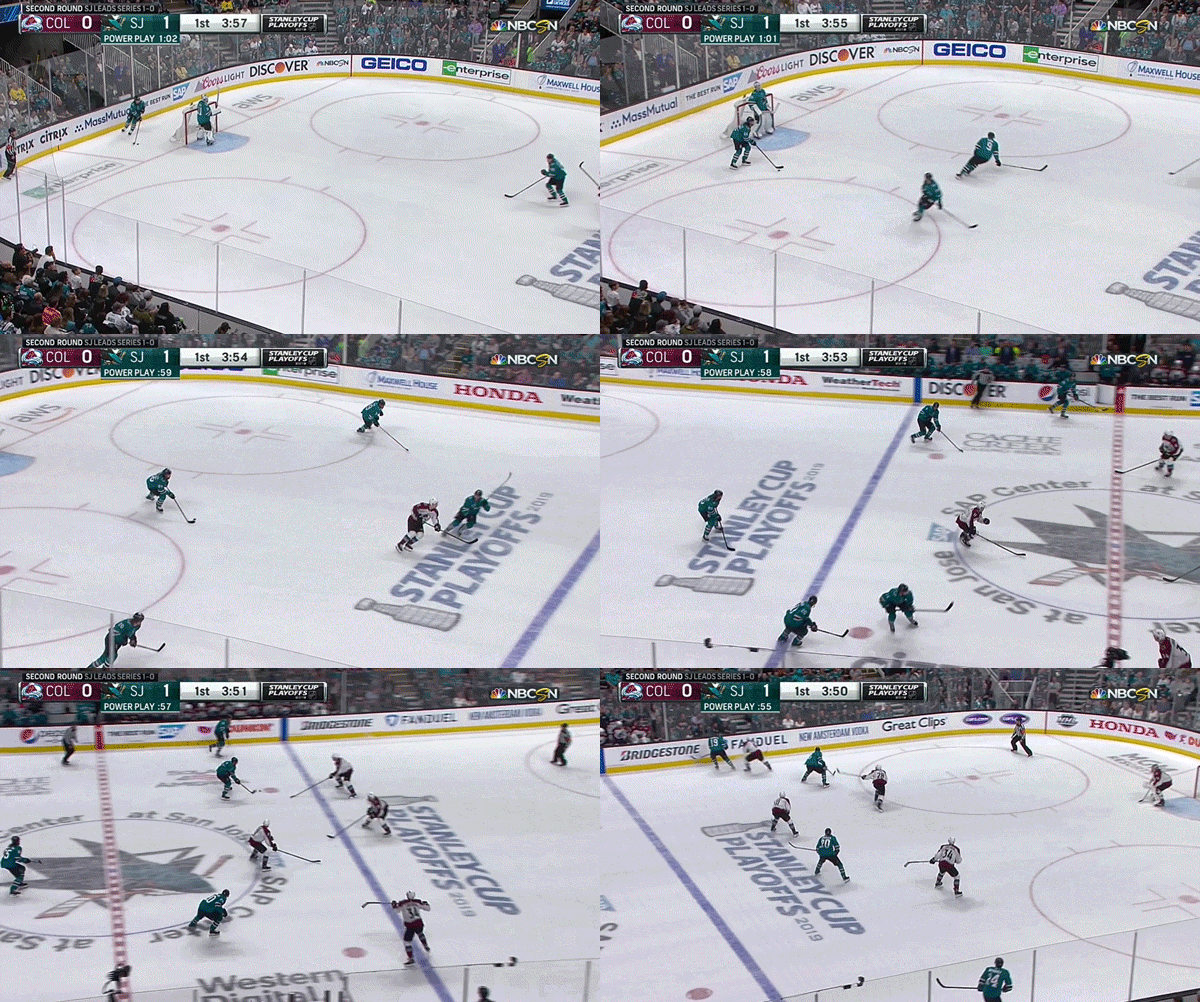
On this breakout, the entire power play unit comes up the ice together — once again, Karlsson is the focal point, as it’s incumbent on him to get the opposition’s F1 penalty killer (that’s the PK’er closest to the puck) off balance, then hit an open Sharks forward in stride with a pass.
You can see both breakouts, back to back, in this January 2020 game:

Enter Rocky Thompson.
“He’s strong with his power play philosophies. Lots of different breakouts,” said Chicago Wolves assistant coach Bob Nardella of Thompson, his head coach from 2017-20. “Some of the teams we played, not many teams vary with their power play breakouts. But we did. He was very creative with that.
“Speaking for my league, Milwaukee, they had two breakouts. Iowa. They stuck to it and they were very good, those teams.”
With that in mind, I re-watched Wolves games to get an idea about the breakouts that Thompson might incorporate into the San Jose Sharks power play — if and when he joins the Sharks.
I focused on Erik Brannstrom’s time with the Wolves, as he was probably Thompson’s most adept QB in Chicago.
A former NHL coach added: “If you don’t have the one guy to carry the puck, he’s average? I can tell you that you’re going to be struggling to find the guy to carry the puck all year.”
If Karlsson is healthy, the Sharks should be covered in that department.
Anyway, two Wolves games stood out, both against the Grand Rapids Griffins over the course of two weeks. It’s worth recognizing that Thompson wasn’t changing things up for change’s sake — the Griffins ran an aggressive PK, a lot of pressure up ice:

I watched other Wolves games against different opponents where there was far less variety in Chicago power play breakouts, a consequence of the forecheck that the opposition penalty kill was running.
“You’ll tell your team, the first one we use is the one-man drop, if it doesn’t work, go to the two,” the coach, who watched these clips too, offered. “The only difference really is look at the opponents’ forecheck: If their forecheck is early, so it’s early drop. Then middle, then late.”
Seven — yup seven — Wolves power play breakouts caught my eye over two games against the Griffins.
The first four breakouts that I’m spotlighting are from February 10, 2019.

Okay, just to make it clear, Thompson wasn’t re-inventing the wheel in Chicago and he won’t in San Jose. It’s better to think of him more akin to a musician, who’s writing variations on a theme.
This Erik Brannstrom (26) drop pass with two Wolves coming from behind with speed doesn’t look much different than the Karlsson examples from above.

But here’s a variation on a theme: Dylan Coghlan (15) quarterbacking, one (not two) Wolves players coming from behind to accept the drop pass.
Notably, Coghlan hangs around to run interference on the Griffins F1, helping T.J. Tynan (18) weave his way into the zone.
Before you teach your team too many wrinkles, it’s important that you know your personnel.
“You gotta know your team. The team I had, we were a fairly dumb team. All those options, they would’ve fucked everybody up,” the coach laughed. “One guy would be doing it right, the other three would forget.”

Thompson, however, didn’t have that problem in Chicago and shouldn’t in San Jose.
Here’s another variation: Again, it’s Coghlan quarterbacking, one Wolves player coming from behind. But this time, instead of picking the Griffins F1, Coghlan hangs around to be a pass option.

This resembles the aforementioned five-man swing, but a couple differences stand out.
First, it’s closer to a three-man swing, as just three Wolves are in motion, as opposed to the five Sharks in motion in the previous clips.
But more importantly, like the drop pass, the first puck carrier (Coughlan) uses the speed from behind (Tynan) — however, instead of a drop, Coghlan forwards the pass into Tynan’s stride.
This throws the Griffins F1 off, as he might’ve expected a more traditional swing breakout, quarterback (Coghlan) leading it and looking for a pass option further up the ice.
“You have to be flexible with all the systems. You have to be flexible to adjust,” the coach said. “That’s what Rocky will do well. His systems would allow the adjustments.”
Okay, now let’s finish up with three breakouts from February 23, 2019:

Once again, variations on a theme: It’s a three-man swing, but this time, instead of taking advantage of speed coming from behind, Brannstrom gets it ahead Daniel Carr (7) in stride.
Carr then exploits a mini 2-on-1 give-and-go with his stationary teammate at the blueline.
“What he’s done is he has two standard breakouts. But what he’s done is added more wrinkles,” the coach noted. “You don’t want to get so complex that fucking players are thinking which one are we doing now?”

This is a half-finished design: On a one-man drop pass, Coghlan drops the puck to Cody Glass (9)
Keegan Kolesar (20) and Tye McGinn (5) are supposed to criss-cross in front of Glass, then come from behind as drop options. Coghlan runs interference on the Griffins F1.
Kolesar and McGinn don’t quite execute, but this is essentially a one-man drop that flowers into a two-man drop up the ice.
“You’re always teaching routes. That’s what he’s doing,” the coach said. “He’s just changing the routes in different situations.”

Of course, a power play breakout can’t be robotic.
With the PK literally trying to foil your every move, not every motion can be by design. You need some creativity, which Thompson’s 2019 Calder Cup finalist Wolves certainly possessed.
Brannstrom doesn’t feel comfortable passing it back to either option on this two-man drop pass breakout, a credit to Grand Rapids’ pressure.
Instead, Brannstrom hits a stationary Brooks Macek (17) on the opposite center ice wall.
The Wolves then improvise a double-drop: Macek drops it to Tynan, who drops it back to Macek. With all four Griffin PK’ers engaged around Macek and the right wall, that leaves Curtis McKenzie (10) by himself by the left blueline. Macek exploits the weak side with a pass to McKenzie, boom, entry.
“There’s five guys against four. Somewhere in there, you have to find a one-man advantage,” the coach noted. “That’s a creativity thing, players have to read off each other.”
The coach mentioned that the last significant power play breakout innovation was the emergence of the drop pass roughly a decade ago.
“It’s not a re-invention here. It’s well-executed, it’s well taught.”