
 Sheng Peng

Ask anybody what’s been wrong with the San Jose Sharks for the last two years and they’ll say goaltending.
Certainly, they wouldn’t be wrong: In each of the last two seasons, the Sharks have had the second-worst Save % in the NHL.
Further to the point: San Jose had a .896 Save % this season; league-average Save % was .903. If they had managed say an above-average .910 — placing them ninth in the league — they would’ve given up 35 less goals and shrunk their overall goal differential from -50 to -15.
Of course, goaltending hasn’t been the only problem for the sorry Sharks: The struggles of Martin Jones and company have obscured other areas just as troubling.
Take, for example, the power play. The Sharks’ 14.1 success rate % this year was their worst in two decades, since 2000-01’s 14.0. 2019-20 was better, but their 17.5 was just good enough for 23rd in the NHL.
Let’s do the same exercise: The league-average power play in 2020-21 succeeded at a 19.78 % clip. If San Jose had reached just those heights, they would’ve scored nine more power play goals.
That doesn’t sound like a lot more scoring, but coupled with better goaltending, you start to see the obvious blueprint for how to improve the San Jose Sharks next year.
So how can the Sharks turn their PP fortunes around?
Exclusive micro-stats from SPORTLOGiQ — from both this campaign and Peter DeBoer and Bob Boughner’s 2019-20 tenures behind the bench — shed some light.
Shoot from the Slot
Per SPORTLOGiQ, about 75 % of all goals are scored at 5-on-5 from the inner or outer slot areas. We’re talking about the power play here, but it stands to reason — try to shoot from the green and blue areas in any situation if you’re trying to increase your chances of scoring:
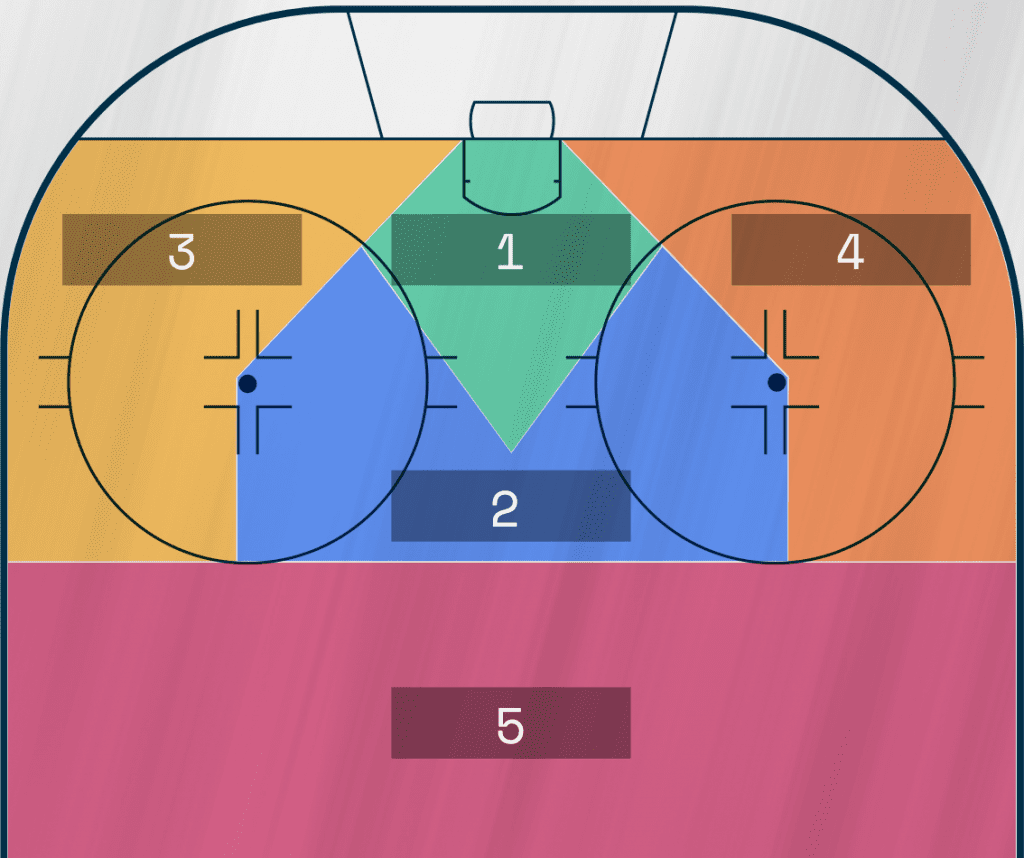
What’s interesting about the San Jose Sharks is how much they’ve declined in these Per 60 categories under Bob Boughner and company:
| Time | Coach | PP Passes to the Slot | PP Shots on Net from Slot | PP Inner Slot Shots on Net |
|---|---|---|---|---|
| From 10/2-12/10/19 | DeBoer | 1.73 (5th in NHL) | 1.22 (4) | 0.54 (6) |
| From 12/11/19-3/11/20 | Boughner | 1.31 (21) | 0.93 (17) | 0.44 (16) |
| 2020-21 | Boughner | 1.29 (20) | 0.87 (23) | 0.42 (21) |
In terms of actual production, DeBoer’s 2019-20 San Jose man advantage wasn’t exactly devouring the competition — they were 23rd in the NHL when he was fired — but their process seems healthier.
There’s something to be said about personnel and systemic changes too — Boughner can’t be blamed for losing Joe Pavelski’s prowess in the slot or Joe Thornton’s passing touch — maybe the San Jose Sharks concentrated less on attacking from the slot because they didn’t have as much skill in getting to that area as before? It’s also worth noting: Steve Spott ran DeBoer’s PP, while Rocky Thompson rans Boughner’s PP this season.
Regardless, spiking their attack rates from the slot next year could certainly add a few more power play goals.
Win More Faceoffs
This is rather obvious: When you lose Pavelski at the faceoff circle, you’re missing something.
In 2018-19, Pavelski (56.5) and Tomas Hertl (57.7) took the majority of the Sharks’ 5-on-4 draws. In 2019-20, Hertl (56.5) took on the lionshare, with a lot of help from Evander Kane (50.7) and Thornton (51.9). This season, Hertl (57.5) and Logan Couture (52.8) took the bulk.
This underscores another apparent change in philosophy from DeBoer to Boughner.
DeBoer emphasized a lot of set plays, quick shots from the slot off a PP faceoff win. Boughner doesn’t seem to:
| Time | Coach | PP OZ Faceoffs Win % | PP % Faceoffs Won Resulting in Shot Attempt from Slot |
|---|---|---|---|
| From 10/2-12/10/19 | DeBoer | 58.6 (9) | 40.4 (2) |
| From 12/11/19-3/11/20 | Boughner | 52.9 (27) | 25.0 (21) |
| 2020-21 | Boughner | 56.3 (15) | 26.7 (17) |
Are the San Jose Sharks probing for better shots after winning the draw?Of course, it’s easier to get a shot off the draw if you actually win the faceoff — something Boughner’s teams have struggled with — but it also seems to be stressed less.
There’s no right answer here — shoot quick or hold for a better opportunity — but it’s a shift, for sure.
Control the Puck
In some ways, San Jose was actually better in this category under Boughner.
This season, their PP Controlled Entry Success % was 63.9, good for 14th in the league. Under DeBoer last season, they were 26th at 60.8 %.
And indeed, Boughner and Thompson were more creative in their entries than DeBoer and Spott.
However, this relative success with “breaking into the zone” with control didn’t translate to much puck possession: They were 28th in the NHL with a 60.3 PP % OZ Zone Time.
Essentially, the Sharks didn’t hold onto the puck a lot in the offensive zone on the PP. That sounds counter-intuitive to success on the man advantage.
Recover the Puck
There were a lot of complaints this year from San Jose Sharks players about too many one-and-dones on the PP. That means San Jose gains the zone, but they’re quickly booted out.
Underscoring this, San Jose was just 19th in the league with a 62.5 PP % OZ Shot Attempts Recovered. Simply, they weren’t great about getting the puck back on the power play.
Funny enough, they did a good job of recovering rebounds: They were eighth in the league with a 62.7 PP % OZ Rebounds Recovered.
Rebounds are obviously shot attempts too, suggesting that the Sharks were good at fetching the puck around the front of the net, but awful at getting it from the corners.
Focusing on the front of the net, as we noted in the beginning of the article, is a good thing. But these rebound recoveries apparently didn’t lead to many quality opportunities — remember that San Jose was just 21st in PP Inner Slot Shots on Net.
Summary
In the end, it’s about personnel. You’re not going to score a ton of power play goals if minute-munchers like Erik Karlsson and Brent Burns have declined as sharply as they appear to have.
But if you’re the San Jose Sharks, these are some elements to look for if you’re looking for PP help from outside or within: Skaters who can distribute the puck to the slot, find soft spots in the slot to shoot, help win faceoffs, hold onto pucks, and recover pucks.
Obviously, finishing ability trumps everything.