
 Sheng Peng
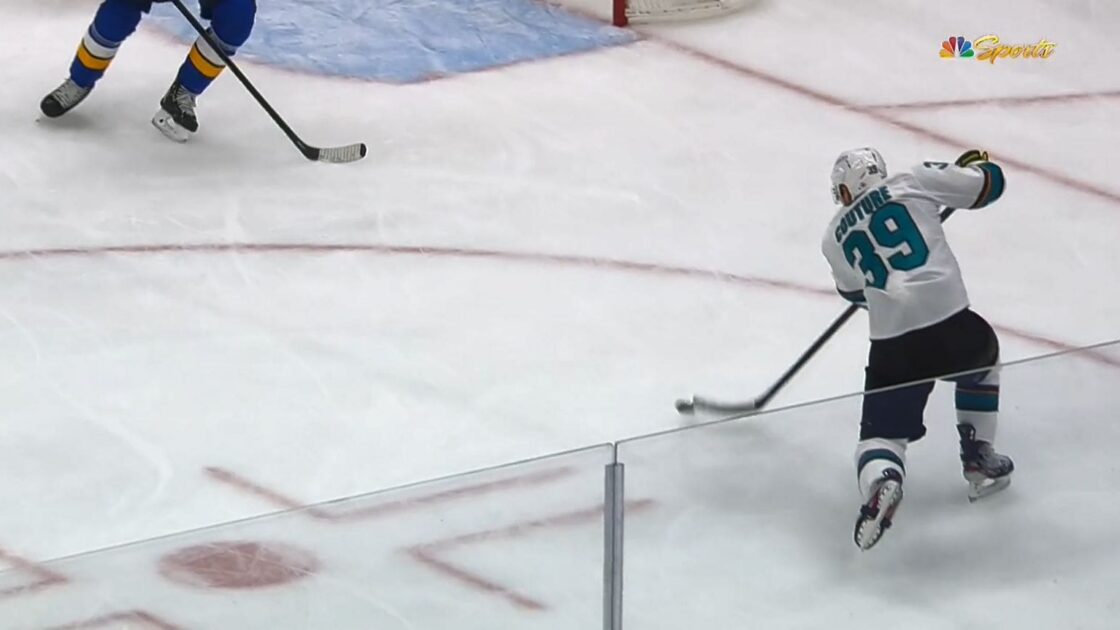
Most of the San Jose Sharks’ best-laid plans are going awry.
Erik Karlsson, Brent Burns, and Marc-Edouard Vlasic aren’t combining to dominate at either end.
Noah Gregor is not proving to be a solution at third-line center.
Martin Jones and Devan Dubnyk aren’t supplying improved goaltending.
In turn, the team defense isn’t doing the goalies any favors either.
And yes, it’s just three games. As Burns put so well yesterday, the team’s had an abnormally long lay-off:
Understandably, it’s hard to ask San Jose Sharks fans, who have had either bad hockey or no hockey for the last 20 months, to be patient.
Good news is, there’s one key facet of Sharks hockey that appears to be following the off-season script — and a lot because of Karlsson and Burns, among others.
Let’s take a deep dive into a power play that’s already scored five goals, what’s clicking?
Also, we’ll break down one of the uglier San Jose Sharks’ shifts last night and how that’s symptomatic of what’s plaguing them in all three zones at 5-on-5.
Easy to Play Against
There’s no two ways about it, San Jose was easy to play against last night. As much as fans may roll their eyes at the “hard to play against” mantra, watch this shift, and you’ll see why that cliche endures:
“Most of the offense that we’re giving to other teams is starting from 200 feet away from our net,” Boughner said today. Case in point:
0:00 It’s easy to blame Kevin Labanc (62) for having little forecheck effect, but it’s not his fault. The Timo Meier (28) dump-in is an easy retrieval for Justin Faulk (72) and the St. Louis blueliner has plenty of time to move the puck. Meier doesn’t put it in a place, say dead in the corner — which isn’t an easy play — that will give Labanc an extra split-second to bear down. Meier follows up on Marco Scandella (6), but the Sharks are way behind on the forecheck.
0:05 Notice Ryan O’Reilly (90) building speed from behind Meier. Scandella tosses it at a stationary Zach Sanford (12) — easy pickings for a fresh Patrick Marleau (12), right? But Sanford takes advantage of a mini 2-on-1 and gives it to O’Reilly in stride.
0:08 In part because Marleau committed toward Sanford, he can’t quite keep up with O’Reilly. The 2020 Selke Trophy winner has the neutral zone all to himself, backing off Erik Karlsson (65) and Brent Burns (88) with his speed.
“Sometimes it’s a F3, third forward high, he’s supposed to be in a soft lock position, [but] he dives in,” Boughner pointed out today, describing his team’s many 5-on-5 mistakes.
A “soft lock” means a defensive player will be in charge of covering an area as opposed to specifically covering (or “hard lock”) another player.
00:10 O’Reilly, on entry, drops it off to right winger David Perron (57). Faulk also fills the right lane. But it’s still a three-on-three down low.
00:11 Between Karlsson and Marleau, however, they pick up neither Perron or Faulk. Marleau doesn’t tie up Faulk’s stick; Dubnyk also fails to make the stop.
So will San Jose’s timing and reads improve in the next couple weeks? The jury is out on that because their overall talent is questionable. But as this shift illustrates, it’s not simply a forwards problem or a defensemen problem or a goalie problem.
It’s three zones and six players of “easy to play against” hockey.
Seven Seconds or Less
More than a decade ago, Mike D’Antoni revolutionized the NBA when he implemented “seven seconds or less” basketball with the Phoenix Suns.
Per Breakthrough Basketball: “The Suns’ philosophy is to get a shot within the first 7 seconds. That creates a pace that forces players to get up and down the court. This creates defensive breakdowns because the defense cannot recover in time.”
That sounds a lot like the Sharks’ power play strikes last night:

Karlsson looks up toward the St. Louis bench: He recognizes that the Blues are changing penalty killers, so he gains the zone with urgency. It’s a good read and also allows for an easy, uncontested entry.
This is the typical San Jose Sharks power play set-up:
But here, the Sharks don’t wait to set up. Instead, flankers Burns and Logan Couture (39) push the attack, below the tops of the circles.
“Our flankers, our two guys on either side, are not coming up high inside the blueline area,” Boughner noted.
That’s something we’re used to on the Sharks power play: Say a Labanc coming down from the right point, scanning his options. That won’t happen as much anymore; Boughner and associate coach Rocky Thompson appear to want the flankers lower in zone.
Tomas Hertl (48) walks down the slot, creating an attack triangle with Burns and Couture. Evander Kane (9) is the late man, looking for rebounds or creating a mini two-on-one with Hertl against Ivan Barbashev (49)
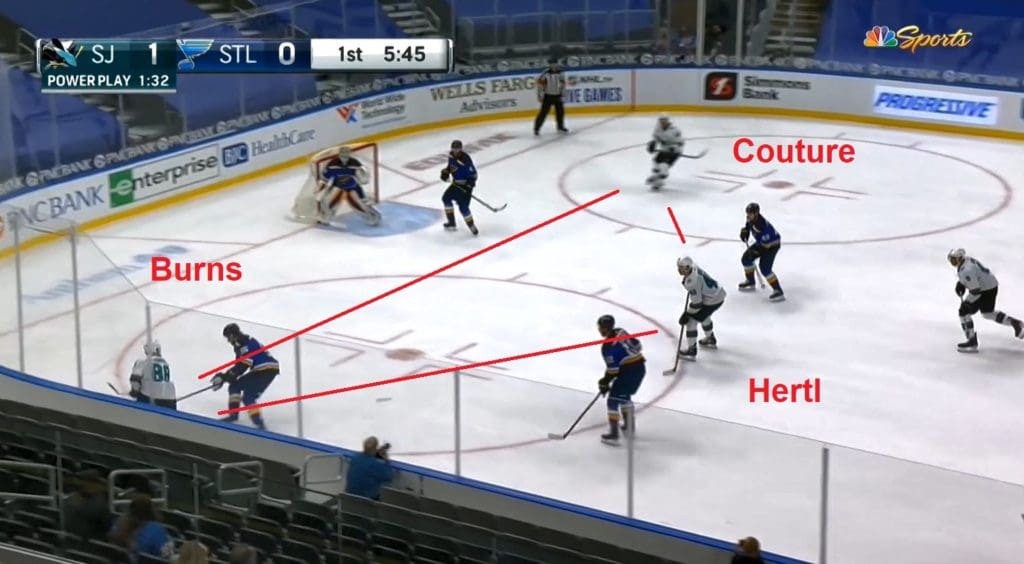
“We want to make sure we’re making that triangle below the tops of the circles,” said Boughner.
Of course, you need a ton of skill to pull off this “seven seconds or less” man advantage. Different angles of the ensuing Couture goal give you an idea of how talented the best San Jose Sharks players (still) are.
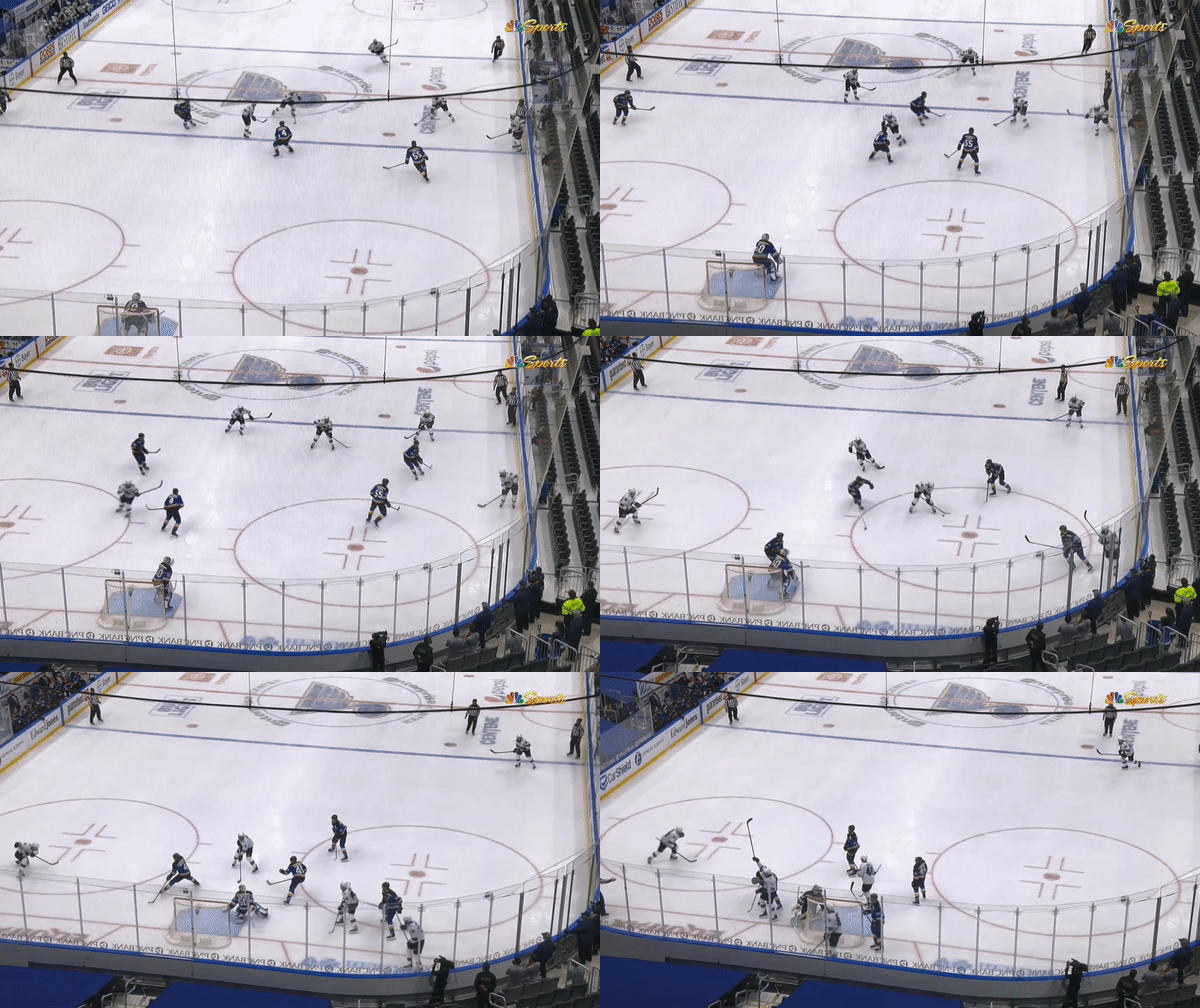
Karlsson pulls up on zone entry — he’s playing fast but cool, sucking the high penalty-killing forward (Sanford) toward him. Karlsson’s patience with the puck helps open the center lane for Hertl.
Along the right wall, Burns reaches around 6-foot-6 Colton Parayko (55) and fires a hard backhand pass into Hertl’s wheelhouse. Obviously, the 6-foot-4 Burns’s reach matters here and the velocity of the pass doesn’t allow Sanford to recover.

Then, Hertl flashes his own elite patience and vision. He feints shot, drawing the eyes of Carl Gunnarsson (4), who’s in front of the net. Barbashev tries to block the pass, but the second he opens up, Hertl fires a flat no-look pass beneath his stick.
Because of Hertl’s deception, both Gunnarsson and Jordan Binnington have no chance.
Now let’s take a look at Burns’s goal:

First, Karlsson shows great “pop” with his feet leading the rush here. His ability to handle the rush defensively has been fairly criticized, but let’s not forget what he’s still good at too.
In other words, it’s not all bad or all good. Just look how he picks up his pace as Oskar Sundqvist (70) approaches.
What else stands out about this goal? Positionless hockey. Kane comes down the left wall, usually Burns’s domain. Burns heads toward the net, usually Kane’s spot.
If you wait for the guys to get to their spots on the PP, that gives the PK a chance to get set.
Naturally, positionless, quick strike hockey requires players skilled enough to switch to any position on the fly.
And Burns, of course, is no stranger to playing forward, as he pots “a goal scorer’s goal.”
So coincidentally, both of these goals were scored seven seconds or less upon entry.
Not a coincidence?
San Jose’s quick strike mentality on the power play.
Labanc laid it out in training camp: “Get that speed coming into the zone.
“It’s hard for the PK unit to set up if we’re coming in with speed. If you can score on the rush, why not? Instead of stopping, setting up, then the PK sets up.”
The San Jose Sharks were 23rd in the NHL with a 17.5 Power Play % last year, but they’re on their way to much better this season.
“We feel dangerous. That right there is a huge difference. It’s the mental aspect of it,” Burns shared last night. “Like the PK last year, we felt like we were going to kill every penalty. Confidence goes a long way.”
SPORTLOGiQ STAT OF THE GAME
The Blues had 21 more Controlled Entries, all situations, than the Sharks. This 54-33 advantage didn’t amount to a ton of Offensive Possession Time (St. Louis 6:21-San Jose 5:02), but it illustrates how much more the home team had the puck and how easy it was for them to gain the zone with control.