
 Sheng Peng
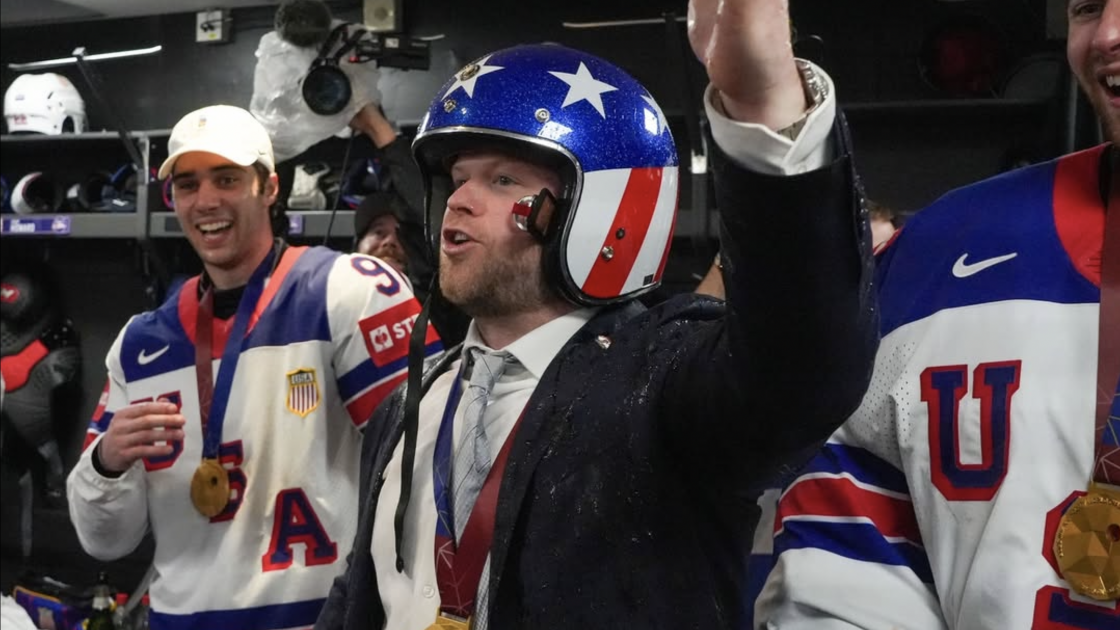
Ryan Warsofsky is a winner.
That might have been hard to tell the last three years with the San Jose Sharks, two years as an assistant coach, this past season as the youngest head coach in the NHL, all well out of the playoffs.
But the 37-year-old has just led Team USA to its first stand-alone World Championships gold in 92 years, topping Switzerland on Sunday.
For Warsofsky, winning has come by the rule of three.
In 2019, Warsofsky won the Calder Cup as Charlotte Checkers assistant coach. In 2022, he won the Calder Cup as Chicago Wolves head coach.
Hopefully, this portends well for the San Jose Sharks in 2028.
Throughout this past season, San Jose Hockey Now caught up with a number of Warsofsky’s former associates and players to tell us more about the rookie NHL bench boss.
Here’s what assistant coach Bob Nardella, winger Stefan Noesen, defenseman Jalen Chatfield, and goaltender Pyotr Kochetkov, all part of the Wolves’ championship-winning 2022 squad, had to say.
“He’s one of the best coaches I played for,” Chatfield said.
Nardella and Noesen talked about how Warsofsky helped make Noesen a full-time NHL’er, Chatfield spoke on why Warsofsky will be a good fit for the rebuilding San Jose Sharks, and Russian Kochetkov spoke about how much he enjoyed playing for him.
Stefan Noesen & Bob Nardella
Stefan Noesen’s career was going in the wrong direction when the 28-year-old winger joined the Wolves before the 2021-22 campaign.
A 2011 Ottawa Senators’ first-round pick, he had become a journeyman, stops with the Anaheim Ducks, New Jersey Devils, Pittsburgh Penguins, San Jose Sharks, and Toronto Maple Leafs organizations, before signing with the Carolina Hurricanes. In his previous two seasons, he had played for seven NHL/AHL teams, including six goals in 39 games over parts of two years with the Sharks.
But under Warsofsky, alternate captain Noesen exploded with 48 goals in Chicago, more than tripling his previous AHL high of 14. The next season, he was full-time with the Canes, becoming a bona fide power play specialist. All this led to signing a three-year contract with the New Jersey Devils in the summer of 2024, and an NHL career-high 22 goals this past season.
Noesen, on what Warsofsky’s impact on him was:
I thought being an older guy [myself]—kind of going up and down, had some good little NHL stints and going back down to the minors and finding my game—he was pretty influential.
He wanted me to be a big part of that team and play a big role, so he kind of let me do my thing, and he helped me get back to the player I could be. We had the system, he also helped me grow as a person, too. I’m very old school in a lot of ways—and he’s that new era coach—but has still some old school tendencies to him.
He really taught me how to try to get to the young kids, because that’s a big thing. Some of the young kids are a little more sensitive these days. When we were growing up, we got beat with paddles. Nowadays, that’s just not a thing anymore, right?
The way that you talk to certain people can get the most out of them. That’s something that he taught me a lot, and you can obviously see he’s the right person.
Nardella, on helping Noesen channel his emotions positively:
It was just the one year, but I think early in that year, he was very vocal, but sometimes his message was delivered the wrong way. He was definitely a leader, but he needed to check his emotions a little bit better and he really did, and he turned out to be a huge leader for the team. The team won a championship.
Noesen, on those emotions:
I just didn’t want to lose, you know? I don’t think anybody wants to lose, right?
Take it for whatever you want to call it—emotional, caring, whatever it is. Warso might be the most emotional person on the planet—he wears heart on his sleeve, and he’ll go to war for anyone. As you see, he already got fined once this year, which is pretty funny to me, but that’s him. He’ll go to war for anyone. Once he cares about you, he’s all in.
He taught me, he helped me with that. I was just a little more old-school, and with that new wave, and there’s different ways to be captain.
Noesen, on why he thinks Warsofsky is a good fit for the rebuilding San Jose Sharks:
He understands the older way of the world, and he understands that there’s a new wave coming.
And there’s no better fit for them.
Nardella, on what he noticed about Warsofsky when he first met him:
He’s wise beyond his years is what I noticed. He’s an old soul in a young man’s body.
Noesen, on Warsofsky getting the best out of him on the ice, especially on the power play:
I mean, I’ve done that my whole life, so it was just finding someone to actually believe in you, give you a chance.
Getting on the NHL power play is one of the hardest things in the world to do. My first two years I was in the AHL, and coming out, I was a net front power play guy. Then I got hurt my first two years, so then I was reinventing myself, reinventing my body, making myself known again.
I went to San Diego, was on the power play there, but it wasn’t the same type of thing, right? Then finding guys that trust each other—it’s getting the right system, it’s getting the right people.
It’s me and [Andrew] Poturalski, we fed off each other. When pucks roll through you, you’re gonna score a lot of goals, you’re gonna get a lot of points. When the coach trusts you to do that, that’s just how it goes. I obviously did it in Chicago, but I’ve always had it, never had a chance to really show it, right?
But that’s just all coaching, it’s all finding someone to trust you. Even when I got here [with the San Jose Sharks], I was in Wilkes-Barre before that, and I had seven or eight power play goals.
It wasn’t really just one person, I’ve always kind of had it, just trying to get a coach to give you a chance. That’s all you want.
Nardella, on seeing Warsofsky develop players like Noesen and more:
It’s not just the young guys that could develop, a guy like Stefan Noesen, you know, he came in, he bounced around, he was in a lot of places. Came in and he was spoken to quite a bit and kind of turned his career around, in my opinion. He’s been in the NHL ever since.
Then you look at some younger guys, [like] Jack Drury. He’s very good at communicating with them, whether they like what he wants to say or don’t like it, he’s still going to communicate and try to get the best out of them and do what’s best for them.
It’s the communication and then the attention to some details that are important. Getting to know guys, getting to know their personalities, how hard to push them, when to back off. He’s really good at reading that stuff.
Pyotr Kochetkov
Don’t tell Pyotr Kochetkov that Warsofsky has a problem with Russian players.
That’s what Nikolai Kovalenko and his father, ex-NHL’er Andrei Kovalenko, suggested at the end of the season.
But Kochetkov had nothing but praise for Warsofsky, who was his first North American pro head coach when he came over from the KHL in early 2022.
Kochetkov’s impressions of Warsofsky:
We’ve been together in the Calder Cup, he was my first coach in North America. I really like this guy, actually. When I came and didn’t speak English, he tried to help me with my adaptation [to the country and] team. He gave me a chance to play in the NHL and playoffs—in the most important games. I like this guy. If this coach stays a long time with the Sharks, it will be a good team in the future.
He’s strong. He fought for me.
Jalen Chatfield
Like Noesen, Jalen Chatfield has been in the NHL entirely since his time with Warsofsky.
Signed by the Canes to a two-way contract from the Vancouver Canucks in the summer of 2021, the defensive defenseman used that Calder Cup-winning campaign as a springboard to a three-year contract with the Canes last summer. He’s blossomed into a middle-pairing blueliner for a perennial contender.
Chatfield, on his impressions of Warsofsky:
Really good—young coach, player’s coach, but also serious at the end of the day. He coached a great team, great system, and he brought it and was fun to be around. I can definitely say he’s one of the best coaches I played for. Well-deservedly, he’s coaching in the NHL now.
Chatfield, on what makes Warsofsky a player’s coach:
Just your personality, right? Like I said, it was definitely a balance. He wasn’t just one of the boys—usually the younger assistant coaches can be a little bit closer—but he had that healthy balance where you could laugh with him, but you also respected what he said when it was serious. A lot of it probably has to do with personality and him being a little bit younger, but like I said, he was a great all-around coach and he did everything.
Chatfield, on how Warsofsky had his back:
[For] good and bad.
He’s a big part of my career changing—going down there and playing in the AHL and winning that championship and being coached as good as I was, he was a big part of that. If I wasn’t playing well, he wouldn’t be afraid to pull me in and tell me, “Carolina wants to get you up there, but you gotta be playing good hockey down here.”
I had a lot of respect for him…Definitely, he cares a lot, and you can tell by that.
Chatfield, on how his career changed direction that season with the Wolves:
It was a big change.
There was a lot of stuff, it wasn’t just one single thing. It started with a mindset shift in the offseason—upped my training, skating at 6 AM, skating twice a day, surrounding myself with the right guys.
Coming to Carolina was huge, getting sent down that first year was a bummer for me, but it was more about just getting down there, getting to work, and trying to get back up to the NHL.
Being able to do that and playing with as good a team as we had in Chicago and that group of guys in the locker room—from top to bottom, the coaches, the players, the media, I loved playing there, and it was a great experience. It did nothing but gain confidence for me and show me that winning is the most important thing. We won all year, and it shows how fun that is.
Chatfield, on how Warsofsky specifically helped spur his career change:
The culture you had down there, just winning, bringing it every day and no days off. He was great about that, he was great just being the coach that he is. I think that there were no shortcuts when it came to him, we always were putting in extra work, and his game plan was dialed-in. We did what Carolina wanted us to do, so when I got called up, I knew right away what we were doing, just having that connection with them. From top to bottom, he was huge for that.
Chatfield, on the first time that he met Warsofsky:
I didn’t know he was the coach.
I was confused—I might have met him in Carolina. I don’t know if he was at camp, but I remember the first time, when I shook his hand, he said his name, and I knew the coach’s name, and I was like, “Wow, all right.” I didn’t know how old he was or anything, so it was surprising, but it’s cool. Hats off for him to get in the game that young, right?
If you’re going to be a coach, you want to get in the league as young as possible, and not just get in because it fell into place—I mean, he worked for it. He won a lot of games, and he coached good hockey, he’s a good coach.
Chatfield, on why Warsofsky is the right man for the San Jose Sharks:
You can never teach experience, right?
He’s won multiple times, and he knows how to win hockey. Just talking to him the last time we played him, it’s a culture he’s building around here, and that’s what it starts with. It starts with your older guys, and it trickles down to how you want to coach and how you want to play and how the locker room is.
You can look at us, for example, everybody knows the Carolina culture here. It’s a great locker room, everything from top to bottom, and we work hard and we compete every night. That’s not just something we do, that’s something we live by every day—everything matters.
I think he knows that, he was around here, he knows how [Rod Brind’Amour] is. He knows what he’s doing here—it’s obviously probably gonna take a little bit of time, but they got the pieces here, and they then get the guys to all buy in, get on board. Just like anywhere, the sky’s the limit. You just have to have a group of guys to share that same one goal—that’s winning, buying in and playing for each other.