Andrew C. Thomas is as steeped in hockey analytics as anybody in the industry.
In 2014, Thomas founded seminal analytics website War on Ice. Two years later, the Minnesota Wild hired Thomas to be their Lead Hockey Researcher, a position that he held for three seasons, until he was let go in April 2019.
Shortly thereafter, Thomas appeared on Craig Custance’s The Full 60 podcast. Thomas gave a fascinating look at how NHL organizations are employing analytics, but one exchange in particular caught my attention.
Custance asked Thomas about the accuracy of NHLe (NHL Equivalency) projections when assessing Draft prospects: “How accurate — when you see publicly, a goal in the OHL is worth more than a goal in the Q…”
Thomas flipped the script, trumpeting a more foundational statistic than even goals: “I tend to look at it a different way. If you’re going to ask me about value for a player, and I had to pick one statistic, it would be time on ice. Because coaches know to play good players.
“So if I’m trying to figure out how likely a player is to get time on ice in the NHL, given they were in the OHL or the Swedish leagues, I would try to start with that.”
It’s a sensible answer, that speaks to both new and old school hockey thinking: While analytics people seem to own a healthy skepticism of the on-ice decisions from “hockey men”, we can all agree “hockey men” want to win. And good players help you win — “Coaches know to play good players,” as Thomas noted.
Time on ice, therefore, might be the best indicator of a prospect’s NHL future. At the very least, it’s an essential stat.
But because of the difficulty tracking such a statistic, the NHL has recorded time on ice since only 1997-98. And the AHL?
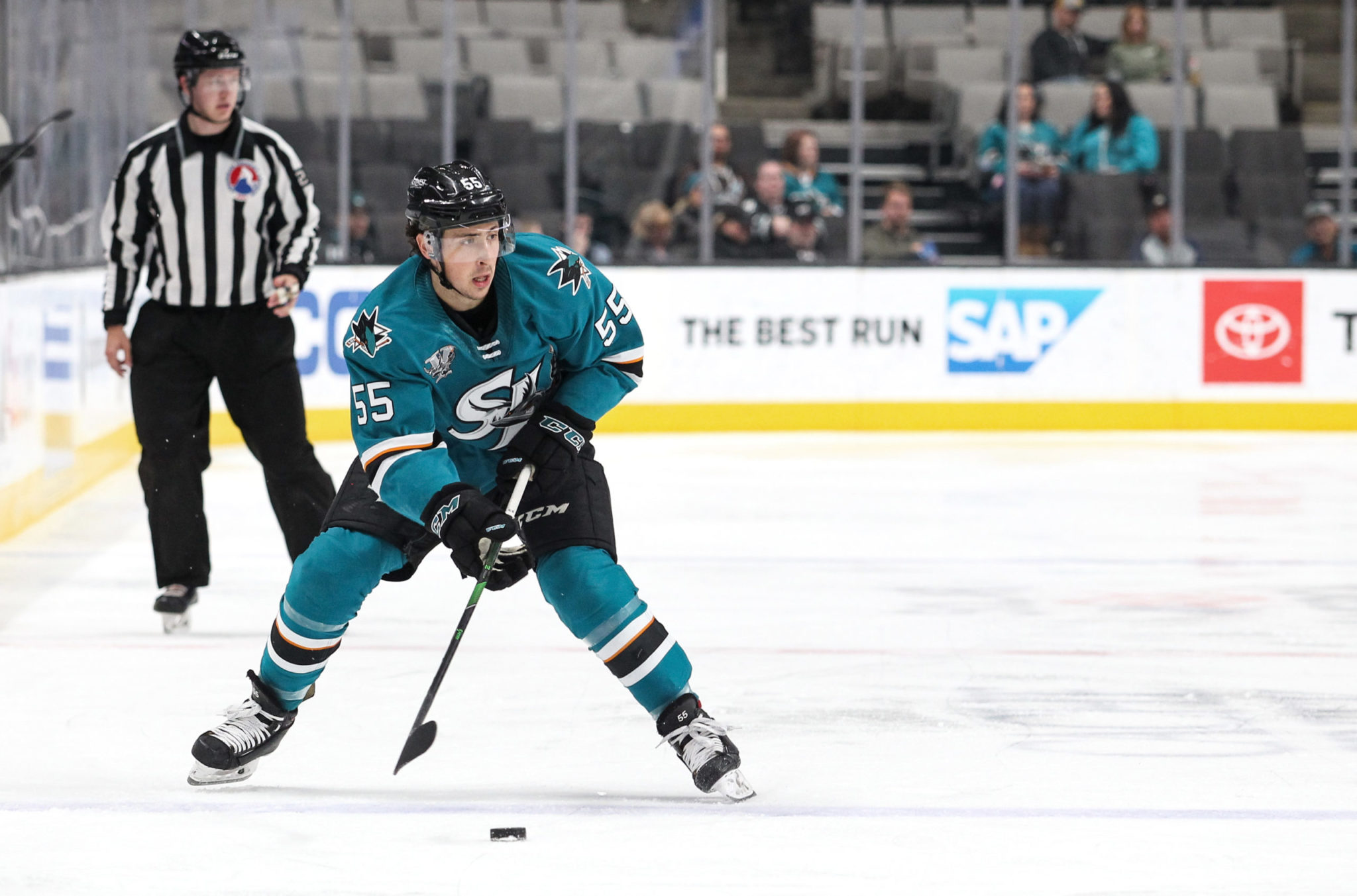
We’ve never had AHL time on ice publicly available — until now. InStat is a third-party company that handtracks games from hockey leagues around the world and they’ve graciously shared their complete 2019-20 San Jose Barracuda time on ice (TOI) data.
San Jose Barracuda (Forwards)

Up top, among most-used forwards, there aren’t too may surprises. Dylan Gambrell, Alexander True, and Joel Kellman also proved to be the most NHL-ready this year. Fans didn’t know Kellman well before the season, but if they knew how much the Barracuda were leaning on him, his December call-up wouldn’t have been the least surprising.
After the top tier, forwards like Jayden Halbgewachs, Joachim Blichfeld, Noah Gregor, and Maxim Letunov might not be as polished, but they’re at least fringe NHL-caliber. They all enjoyed strong AHL campaigns that had them knocking at the NHL’s door.
Halbgewachs, I was told by sources in the San Jose Sharks organization, was a virtual lock to make his NHL debut this year, had the regular season not been paused. It’s worth noting that Blichfeld was the most-used power play forward on the Barracuda.
Jeffrey Viel, Sasha Chmelevski, and Lean Bergmann represent another class of prospects up front.
Viel, judging by his low power play usage, shouldn’t be projected for anything more than fourth-line NHL duty. That said, that means his bar for a big-league job might be a little different than the others. I suspect Chmelevski’s TOI grew as the season progressed. His production was impressive — 26 points in his last 35 games — in relatively limited usage. Meanwhile, Bergmann’s usage surprised me — his meat-and-potatoes game maybe should have translated more smoothly to North American hockey.
At the bottom, there’s Danil Yurtaykin and Ivan Chekhovich, who failed to earn the trust of the coaching staff. More was certainly expected from both, considering their offensive skills.
Another useful exercise with InStat’s data is to look at how Roy Sommer used his forwards compared to Jimmy Bonneau and Michael Chiasson. Remember Sommer was promoted to the NHL on December 12, 2019, and Bonneau and Chiasson took over as co-head coaches.

Antti Suomela’s bump is eye-catching, but he only played three AHL games under Bonneau and Chiasson. Most noteworthy are the increases in Letunov and Chmelevski’s time on ice. Meanwhile, Chekhovich, Bergmann, and especially Yurtaykin’s decreases are alarming. Letunov really did develop as a top AHL player, albeit for a weaker squad. Manny Wiederer’s bump is also worth some investigating, given he’s an RFA.
Before we move onto the Barracuda defense’s time on ice, I’m going highlight a promising non-usage Chmelevski stat. A surface view of Chmelevski and Viel suggests not much difference in terms of production: Chmelevski scored 27 points in 42 games, while Viel scored 30 in 54. But InStat reveals that Chmelevski was second among Barracuda forwards in Primary Assists Per Game (0.58), while Viel was 10th (0.15). Viel was piling up a lot of secondary assists, an indicator, once again, that his NHL future isn’t on the top three lines.
San Jose Barracuda (Defensemen)


Because most of the Barracuda’s top prospects are up front, I’m going to spend less time here. The decrease in 2015 second-round pick Jeremy Roy’s usage does stand out.
Granted, Roy played a handful of games at forward under Bonneau and Chiasson, affecting his time on ice, but there’s every indication that he’s done in San Jose.