
 Sheng Peng
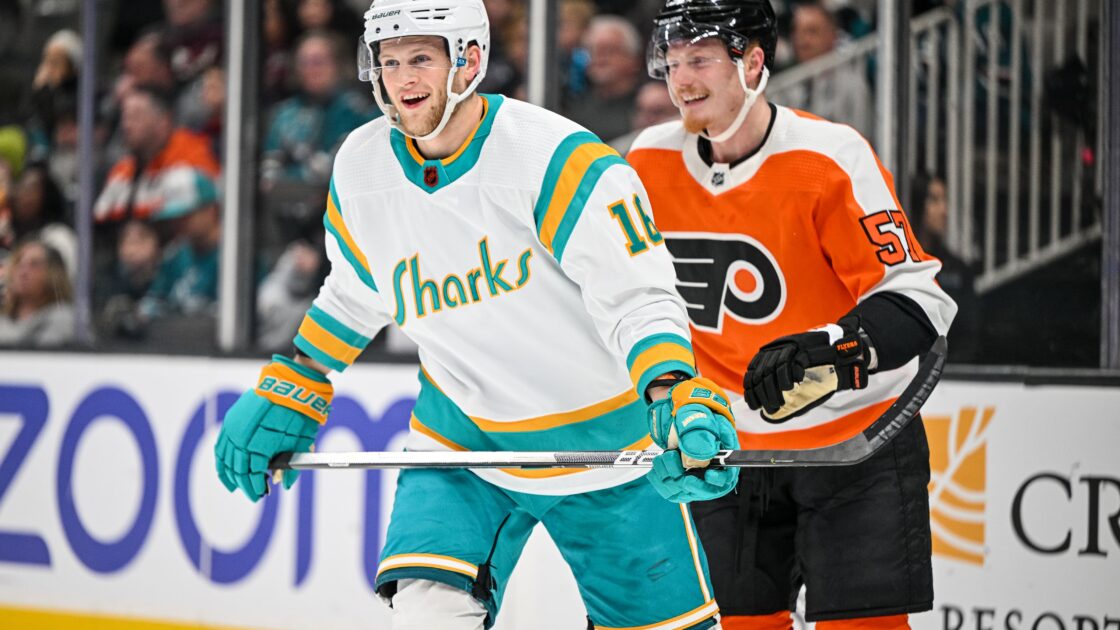
Steven Lorentz’s road to the NHL wasn’t a normal one.
Selected in the seventh round of the 2015 NHL Draft by the Carolina Hurricanes, Lorentz started his pro career in the ECHL with the Florida Everblades. Over parts of two seasons, Lorentz logged 84 regular season games with the Everblades.
Lorentz advanced to the AHL’s Charlotte Checkers and would make his NHL debut for the Hurricanes on Jan. 28, 2021.
The 6-foot-4 center-winger hasn’t looked back since then, sticking in the NHL for good.
The San Jose Sharks acquired the 26-year-old Lorentz from Carolina this past off-season, along with goaltending prospect Eetu Makiniemi, and a 2023 third-round pick for Brent Burns and Lane Pederson.
It’s not typical for an ECHL skater to establish himself as an NHL’er. Underscoring that, there are no San Jose Sharks skaters on the current roster besides Lorentz who have played in the ECHL.
Lorentz isn’t a big-time scorer, but he was no spare part in the trade for Sharks legend Burns.
“We kind of targeted some guys with high character, high work ethic, high compete, and I think they’ve helped change the locker room, whether it’s [Nico Sturm] and Luke Kunin and Steven Lorentz,” GM Mike Grier shared last month. “I think those guys, they’ve come in, all to different levels, but they’ve assumed some leadership of the group. It’s changed a little bit of the locker room dynamic. I think it’s made guys enjoy coming to the rink.”
Lorentz was kind enough to answer questions from San Jose Hockey Now subscribers recently.
He talked about the teenage growth spurt that changed the course of his career, when he went as Batgirl for Halloween, the time that Ryan Warsofsky bowled him over in practice, not getting recognized around San Jose, the weight of getting traded for Burns, and why Nick Bonino should never be locker room DJ.
Steven Lorentz, on locker room stallmate Matt Nieto getting dealt:
Everybody knows he’s been part of the organization for a long time and he was such a respected, soft-spoken guy, when he talked, guys would listen. He’s just a great guy to get along with, hanging out with at the rink and away from the rink.
It’s no secret that he obviously brought a lot to the hockey club, his energy and his offensive role this year. It was great to see him kind of flourish a little bit in a new role.
We’re all happy for him and the opportunity for him in Colorado. It’s obviously a big piece that we’re going to be missing, so it’s definitely an opportunity for some guys to step up and try to fill a role like that. He was great guy, a great hockey player, and we’re gonna miss him.
Lorentz, on growing up a Toronto Maple Leafs fan:
Closest team was Toronto. My dad was a big Leafs fan, so my room had Leafs logos painted all over, and stuff like that.
I had posters of Mats Sundin, who was my favorite player, and Curtis Joseph, all those those older Leafs that are retired now, but I still think about those days. My dad would take me to big games every once in a while, and it was so cool.
Here in the Air Canada Center, where I got to play this year, packed with Leafs fans, and those are just fond memories I have. Growing up, Toronto is obviously a hockey city.
Going to games, just walking around and seeing the Leafs jerseys all over town. I was very fortunate to grow up in such a passionate fan base. The Leafs will always hold something special in my heart.
When you make it to the league, and then you start playing against them, you develop a little bit of hatred for the teams that aren’t your own. I’m happy to be where I am. I’m not cheering for the Leafs quite as much as I used to.
Lorentz, on the growth spurt that saw him grow about six inches and 40 pounds in the space of a year and a half:
I think I was probably 17 when I hit my growth spurt. It was a couple years after everybody else did. I was kind of frustrated at the time because when I was a minor hockey player, I seemed to be dominant when I was younger. But then once guys started growing and I wasn’t, they obviously developed that strength through puberty. I just didn’t have that at the time. It was frustrating for me that at one point, I used to be able to control the game and do what I liked, and then it got way, way harder.
So I had to learn to play as a smaller guy and learn different skills on how to beat guys. I was still fortunate enough to get drafted by the Peterborough Petes in the OHL. I was drafted at 5-foot-9, just under 140 pounds. So I think I was the lightest kid in the Draft and one of the smallest. It was more like a gamble than a sure-fire thing of making it to the league.
I hit a growth spurt a year later, after I was cut from a junior-B team. The local junior-B team didn’t have a place to me, they told me I was a little bit too small.
I played another year of minor hockey with the major midget club, and I hit my growth spurt that year, and I think going into [Petes] camp the following September, when I was 17, I think I was about 6-foot-2 or 6-foot-3 and I was about 180 pounds.
Took a little bit of time to get that coordination back. Obviously, when you shoot up six, seven inches in a year and a half, it takes some time to develop that.
It’s like when you’re clapping your hands, you might look like a seal. You got to figure out how to skate almost and how to handle the puck. It ended up working out, and I was fortunate I had some great coaches to help me along the way.
Lorentz, on if it was a blessing in disguise to play under-sized for a little while and have to learn to compete in other ways:
Of course. Every single guy that’s played in the NHL, I’m sure at one point in their career was a goal scorer and somebody who had offensive abilities.
You got to be able to put up points and it doesn’t matter what league you’re in. You need to be capable of scoring, doesn’t need to be what you’re relied on and what you’re known for. But just having that capability of being able to put the puck in the net is obviously something that almost every single guy needs.
So maybe it was a blessing in disguise that I had to learn to round my game out a little bit and work on face-offs and defensive zone positioning and stuff like that. When you learn that when you’re young, obviously, it just grows more and more as you develop with better coaches as you get older, older.
Maybe when I was young, not having that size was good for the rest of my game, so I couldn’t just go out and physically dominate guys and just be straight offensive.
I guess you could give credit to that lack of growth spurt for learning how to play the game the honest way. Ultimately, ended up where I am, I’m still working on my game, I’m not satisfied, there’s still areas of improvement and stuff like that. I look forward to the challenge every single day.
Lorentz, on going as Batgirl for Halloween in his first pro season:
I think that was more of a rookie thing. I think we all went out Halloween shopping probably that day. That might have been one of the only costumes left. You don’t have to pick straws when you’re the only rookie in that group of guys. You just say you know what, that’s what you’re gonna be wearing, and you got to wear it the best you can.
Lorentz, on getting “rolled” in Charlotte Checkers practice by then-assistant coach Ryan Warsofsky:
No comment.
It’s one of those things, Warsy, he’s such a competitor. If you know him, you might not be able to tell from TV, but if you come to a game and you watch him, it’s insane how emotionally invested he is. He’s almost as into the game as the players are.
When he’s out there practicing, even before the video that Mike took of Warsy [hitting] me in practice, there was another time in the Calder Cup Final, when I didn’t play the Final games, I was just coming off an injury. Like the day we won the Calder Cup and we had morning skate that day. Again, I’m just coming off injury. I had the puck and he decided to just run me over in the corner. No regard for me as a player, just didn’t care. He just really wanted to win 3-on-3 in the morning skate. That’s just who he is. (laughs)
He’s a competitor, it doesn’t matter what he’s doing, he’s going to do everything the best he can. He’s kind of got that bulldog in him. So that’s what we love about him and we wouldn’t want him to be any other way. Hopefully, Mike stays true to his word and doesn’t leak that video because that would be pretty embarrassing. Warsy is a little bit smaller than me, but he definitely has a heart of a lion. So he gave it to me pretty good.
Lorentz, on what happened between he and Warsofsky:
He rolled over me. We were gonna run into each other and he stood me up.
I mean, I tried to let up because I was like, oh I don’t want to run into my coach, and then he just decided to get the elbow up and go right through me.
Lorentz, on if there’s an adjustment now Warsofsky has gone from his head coach with the Checkers to assistant coach with the San Jose Sharks:
It’s funny, because the year that we won the Calder Cup, he was the assistant coach. Then the following year, he became the head coach. Then now again, he’s assistant coach. So I’ve kind of got to see him go from the assistant to the head to the assistant again.
One thing again, that just hasn’t changed is his passion for the game and that kind of bulldog mentality. He doesn’t like anything passive, he just likes aggressive, in-your-face, playing the right way type of hockey.
I think that’s where teams find their success in playing the way that he coaches the game.
It’s, I guess, a little bit easier, [assistant coaches] don’t have to make those real tough decisions, they don’t need to make those real hard decisions that the head coach has to make. So a little bit easier to relay the message to players, either a healthy scratch or if they’re going through a bit of a dry spell.
I guess the assistant kind of steps in and they become relatable to that player. So it’s nice having all coaches on our staff who have played the game at a high level and guys who understand kind of what we’re going through.
What was the biggest adjustment you had to make moving from North Carolina to now living here in the Bay Area? (Jigglz)
It wasn’t a crazy adjustment.
I would say off the ice, I’ve never really been to the West Coast.
I guess getting acclimated to being three hours behind my friends and family at home is something that kind of has been noticeable. That’s kind of really the only thing that’s been like, oh okay, when I finish the game, I can’t just call up my parents or call my girlfriend if she’s not in town. They’ve been in bed for a couple hours.
But I will say that my parents have done a great job staying up for my games, which I appreciate the support more than they’ll ever know.
I’m glad that there’s a lot more restaurants out in the Bay Area than I’ve been able to go to and there’s a bunch in Raleigh, but it’s more of a spread out kind of city.
Obviously, Silicon Valley and San Jose is a lot more tech and that kind of industry. It’s honestly a good change.
I was so accustomed to Carolina and only being a part of that organization that I think the change was nice.
It’s great to meet so many friendly people and Sharks fans around town. I walk around my apartment complex, and there’s Sharks jerseys everywhere. It’s kind of nice, because I haven’t really been recognized per se, so you can kind of hide out in the weeds a little bit.
What is your favorite go-to food spot here? (Jigglz)
I haven’t really been able to explore, I haven’t actually done a whole lot. I’m honestly the wrong guy to ask because my girlfriend is the one who puts it in her cell phone and we kind of just cross them off the list.
But the one place I do want to go to is near Santana Row, I believe it’s Omee.J. I’ve heard good things about that, so I’m looking forward to trying that when I’m back in town.
Steven, I imagine it’s tough being traded for a fan favorite. Did this weigh on you at all? Also, did it make you feel any better after you talked with Mike Grier? What, if anything can you share about that? (Alaskan_ice)
If you look at it from that perspective, there definitely is [pressure]. When you hear a name like Brent Burns coming the one way, it’s just like, wow, that’s big household name, obviously.
I’m sure a lot of people hadn’t heard my name in the past, and they’re probably wondering what the heck was going on. They just gave up a franchise player for someone who’s a little bit more relatively unknown. That’s no issue with me.
You know what, at the end of the day, I’m going to put my heart wherever I’m playing and I’m going to get to know the fans and the organization as much as possible. I was more excited than anything for the new opportunity. I wasn’t really thinking so much about, oh, it’s gonna be a lot of pressure, you know, being traded for a guy like Burns.
It was honestly special, if anything. I would say, if anything else in my career, if nothing else happens that I got to play a great couple years in Carolina, and I was able to come to a great organization, San Jose, for a guy that was an NHL legend.
It’s still pretty cool seeing Burns jerseys all over the place. I used to watch him play when I was a kid too, and I was a fan of his.
It was cool being a part of that trade, but at the same time, I’m loving San Jose, it’s obviously a place where I’ve kind of found a role with this bottom-six. We haven’t been as successful as we hoped on the ice to date with our record, but I think Griersy’s doing a good job bringing in the right pieces and kind of steering the ship in the right direction and that doesn’t happen overnight. I like where things are going, and I think there’s a lot of guys that are impressed and excited about the future.
During the season, what does your typical day look like in terms of training and skill improvement? How many workouts per day do you have? How long are they? And what do you typically work on? (Alex Genadinik)
It’s tough in-season.
It really is what you do in the summer. Summer is more about trying to build that strength. In season would be more about maintaining the strength that you add in the summer. It’s such a demanding schedule and you’re playing pretty much every other night, every two nights. You gotta rest your body too, right? It’s tough to find time to go out and lift weights and stuff like that. You’re obviously getting the best workout you can when you’re playing games.
At the same time, you got to find those days where you have a few days off so you can get a small little lift in.
Lorentz, on what he works on after San Jose Sharks practice:
I try to pride myself on my versatility. Whether it’s picking up pucks and skating hard out of corners and driving the net or just kind of changing directions on my edges and kind of faking in one way and going the other.
Little drills that are very simple and don’t take much, you don’t need a coach, you don’t need a net, just a stick and a puck and you just fire against the boards and just simulate a puck coming around the wall on the offensive or defensive zones.
You just got to pick it up, make a decision quick, what you’re doing with your feet and your head and the body positioning and stuff like that. So it’s just little things.
Now obviously you work on faceoffs and stuff like that too. My percentage hasn’t been as good this year. I’ve taken a lot more draws this year than I have last year, but it’s a work in progress.
Do you like the Pacific Coastline more than the Atlantic Coastline? (KE)
The Pacific coastline has been beautiful. I was able to make a trip up to San Francisco, and we went to the coasts and Half Moon Bay and drove up Highway 1 and just looking at it was incredible. I’ll give the West Coast a point for that. I do love their coastline, it’s beautiful.
The scenery you get when you drive up the mountains [or] big hills, when you look back, it’s like a scene out of a movie most of the time. It’s pretty cool looking out seeing all the people surfing. All the people just enjoying the water and the sand.
Who should be in charge of the locker room music and who would you ban without hesitation? (Bee)
I think Timo should be in charge. He actually mixes it up. He plays the club beats, but he also takes it back to some ’80s tunes every once in a while, which I’m a big fan of.
I think Bonino should never have the DJ. Just something about what he would like listening to would be way different than what the rest of us would like. He wouldn’t care. He would just keep playing his own music, so I wouldn’t trust his taste.
Lorentz, on a musical artist he would associate with Nick Bonino?
Like Fergie. I don’t know, Fergie is like a little bit dated. Yeah, like the Black Eyed Peas. I can see him liking something weird like that. He’s a bright guy, but there’s just something about, I don’t know.
I just like taking digs at Bones too. He’s just a guy for me to go after because he likes to give it to me.
What has the room been like during intermissions with the San Jose Sharks this season? What is your intermission routine? (Colman Baldwinson)
Not a lot goes on at intermissions. It just depends on the bumps and bruises of the game. Obviously, some guys will be in the trainer’s room.
It’s relatively laidback. And it is positive. I know, with our record, it might seem like guys are frustrated, and obviously they are, but we do a good job not really taking it out on each other and pointing fingers.
I think guys do a good job trying to boost each other rather than sit there and point fingers about what’s going on. I think we just sit there if we need to show a few clips and watch some videos on special teams, or this or that, there’s some of the X’s and O’s and we’ll do that.
But again, it’s pretty laidback. Most guys just kind of sit in their stalls and have their waters and rehydrate and just take advantage of that rest before the next period.
Lorentz, on if intermission is like Peyton Manning recently revealed:
I can see how he says that. For a lot of guys, it is like that.
Some guys are pretty low-maintenance. A lot of times, you just find yourself sitting there and just looking at the clock, waiting for the coaches to come back in and give their little intermission spiel, and then you go back out there and do it all over again.
Some guys utilize that 15-16 minutes, whatever it is, and some guys just say, okay, let’s go, let’s get the show on the road.
How did you feel about your own game and what you had to improve to make it at the next level when you were a 12th round pick in the OHL? (Jasdeep)
Yeah, at that point, my career obviously, being very young, I just wanted to focus on becoming bigger and stronger. I knew I kind of had all the tools that I was capable of playing in major junior hockey, but it was being able to grow into my body and build muscle and develop that strength that I played against 17, 18, 19, 20-year-olds.
It’s kind of just follow what the coach’s advice is, and that kind of gets you to where you want to be. It’s such an easy thing, but you know, I’ve always been one that if a coach tells you something, gives you that advice to work on, like, that’s what you work on. It’s his team you’re trying to make, and when you just do that to the best of your abilities, good things usually end up happening.
I was fortunate that I’ve had some great coaches along the way that have helped me play. A lot of guys who have played a lot of NHL games. Learning from guys like that, it’s just easy to pick up on those skills and those pointers that they give you. Ultimately, it’s led me here, so can’t complain.
And then again as a seventh-rounder in the NHL? (Jasdeep)
It was just about playing more consistent and building the speed.
You can do all that stuff in juniors and you can get away with maybe not being the fastest guy in the East Coast League, where I was, and even in the minors, but NHL speed is NHL speed. It’s not just about the skating aspect of it, it’s about thinking the game at that speed.
Just being able to get used to making quality plays at a high pace is something that is hard to teach. Once you get confident, and I think that’s why a lot of high picks go to the minors, they get used to thinking at a speed that’s quicker than junior. it’s quicker than college. Once you get used to doing that, you build your confidence and the next step is the NHL. I was fortunate that I stepped into a great system in Carolina and I was able to find success.
Lorentz, on who or what he credits his increased pace to:
I think the mental side of game has become a lot more important and relevant, I think.
I’m just doing different neurological-type drills and training your brain, I guess? Whether it’s juggling or doing different skills, playing different sports is a big one, kind of just get your brain used to trying to slow things down. When your brain slows things down, then it’s obviously becomes a lot easier to make decisions and use that time to make a decision.
It’s the same thing as being on the ice. Plays happen fast and you got to be able to think what your next move is. What to do with the puck. Where to be in position. I think just training your brain is a big part of the game. If you do that and slow the game down, it becomes a lot easier for you.