
 Sheng Peng
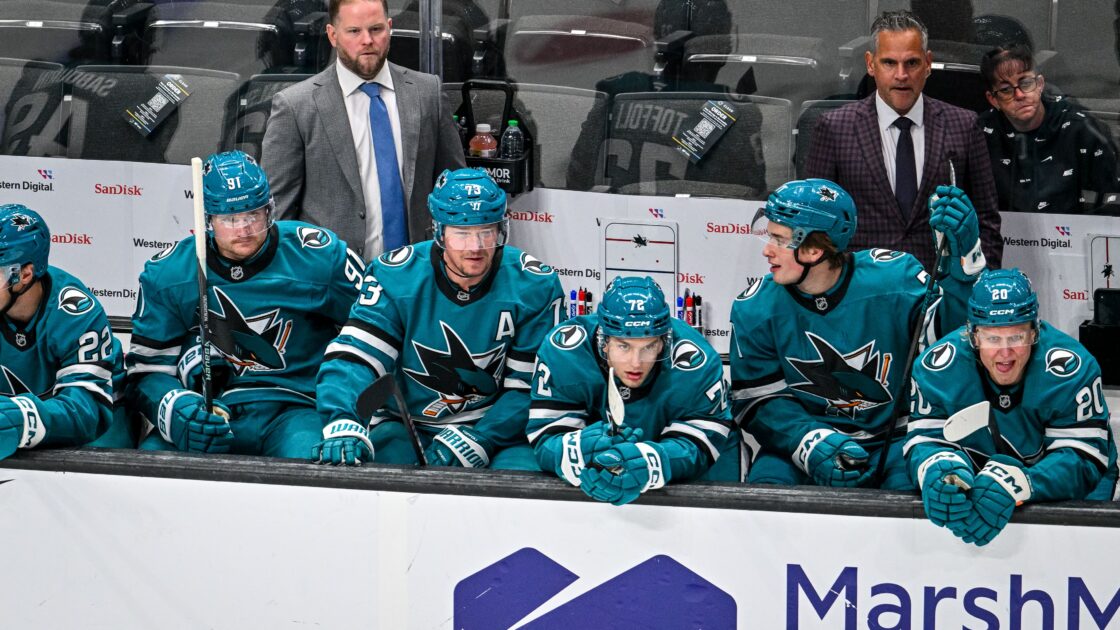
Ryan Warsofsky was just 26 during hockey’s so-called “Summer of Analytics”.
In the summer of 2014, Eric Tulsky and Kyle Dubas were among a number of analytics pioneers hired by NHL teams. Many are still working in the league.
Tulsky, in particular, is an example of the culture shift in the sport.
A chemist by day, Tulsky gained notoriety in the hockey world with his cutting-edge analytics stories and research at SB Nation in the early 2010’s. Hired on a part-time basis by the Carolina Hurricanes in 2014, he’s now the Stanley Cup contender’s GM.
So what’s the San Jose Sharks head coach’s insider view of the rise of analytics? How do the Sharks use them? How does Warsofsky assess “anti-analytics” players like Cody Ceci, Barclay Goodrow, Mario Ferraro, and company?
Sheng Peng: How do the San Jose Sharks use analytics?
Ryan Warsofsky: We use it quite a bit.
I think it’s still very early, in my opinion, the way analytics is used in hockey.
I don’t think it’s where baseball is and whatnot. There’s a lot of variables towards it. In baseball, you know for the most part where the baseball is going. In hockey, you don’t really know where the puck is going.
But I do think there’s some value to it. We use it a lot in our pre-scouts and what teams 5-on-5 or 5-on-4 or 4-on-5, whatever it might be, their data and what their strengths are and what their weaknesses are. We use that quite a bit.
We know line match-ups, expected goals and goals against, and what they’re giving up.
There’s a lot of information. I think you got to kind of balance it out a little bit from the eye test. A lot of times, if I’m looking at something that I see from the data that the team is struggling with, I’m going to watch it. I need to see it from my eyes. But there’s a lot of useful analytic data.
We try to line ours up with our structure, and see what we give up, what we get within our structure [of play]. And then we can kind of match it and then measure it, is our structure working? Is it our structure? Is it our personnel?
SP: Can you talk more about how the San Jose Sharks use analytics for pre-scouts, how you evaluate strengths and weaknesses of the opposition?
RW: I’d say 5-on-5, for instance, it would be maybe a team struggles breaking up pucks coming up the strong side. We gotta influence keeping pucks on to the strong side and force pucks into the middle. And maybe we can capitalize with our F3.
Where do teams struggle, and do they give up [many] slot chances? Okay, we have to get to the middle of the ice. Do they not give up slot chances? Okay, we have to penetrate the middle.
So there’s a lot of data that we sort through, and we try to find team strengths and weaknesses, just like teams are doing against us. And you try to attack those areas. And those are kind of some examples that we look at.
Teams want pucks in the neutral zone, coming to the middle of the ice? Okay, we have to take away the middle of the ice. Obviously, Tampa was really good at that.
Vegas is one of the best teams at driving the middle of the ice, their middle lane drive is the best I’ve seen. And we got to make sure we don’t let them get on line rushes. And how do we do that? We can’t turn over pucks at the blue line.
SP: A player like a Cody Ceci, just for example, his expected goals [differential] is not great. How do you assess a player like that?
RW: A lot of it is his matchups, what his pairing is, home, away. There’s a lot of variables to that for me.
Our personnel, their personnel, whether we can get a match-up, can’t get a match-up, who he’s playing with. There’s a lot of different variables in that. The ice-time, was he stuck on the ice?
Sometimes, you look at some of those expected goals and some of it’s not completely accurate either. A lot of that’s done by a robot and a computer, where we’re doing it everyday, breaking it down. So there’s a lot of different variables.
SP: To a man, to an NHL organization, is the eye test still the bedrock for hockey evaluation?
RW: At least for coaches. I can only speak to the coaching standpoint. If our analytic departments show me something, I have to watch it. I really need to dive in and see it. For most coaches, it’s still the eye test.
SP: You’ve seen analytics’ impact on hockey over the last decade. What have you seen over the last 10 years?
RW: 10 years ago, it was very green, it was very raw, and it wasn’t utilized as much as it is probably now.
But you see a lot of different websites, I’ve been familiar with a few of them now, with different organizations, and I think different organizations use it differently. I think everyone’s still trying to figure out what’s best for them, and they’re building their analytic departments and whatnot.
I would say it’s come a long way in 10 years. I still think there’s a ways to go with it and sorting through things, because there’s a lot of data.