
 Sheng Peng
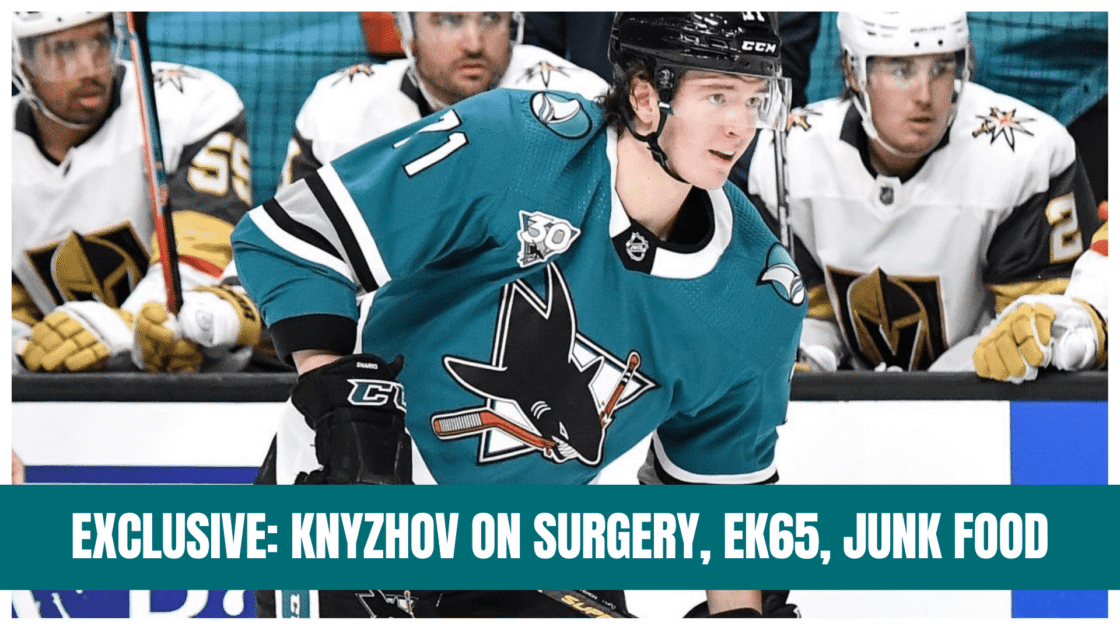
Nikolai Knyzhov has been back on the ice for a few weeks now.
At the end of last season, Knyzhov revealed he had been playing with a sports hernia that would require surgery. This surgery would also keep him from representing Team Russia at the World Championships.
“I’ve been working out for a [couple months] now and been feeling great,” Knyzhov told San Jose Hockey Now from Arizona in mid-July.
The 23-year-old defenseman also revealed a second minor surgery besides his sports hernia: “I also had my ankle done. They just basically took away scar tissue from it.”
Knyzhov says he’s fully recovered from both surgeries, good news for a San Jose Sharks squad that’s counting on him to soak up top-four minutes again after a surprising rookie campaign.
So what’s Knyzhov doing in Arizona? The gregarious youngster — who also happens to be a great storyteller — talked about that, while sharing some of the highs and lows in a hockey career that’s already taken him from Siberia to Arizona to Regina to San Jose.
Knyzhov also was an open book about the junk food diet that held him back in his first season in the AHL, when he realized he could really hang at an NHL level, and the most important thing that he’s learned from defensive partner Erik Karlsson.
Sheng Peng: You were in Arizona last summer too. And as a teenager, that’s where you first played hockey for a North American team. So why has Arizona become your second home in a way?
Nikolai Knyzhov: I’d say probably because of my friends. Just coming here when I was 15, meeting a bunch of guys on the team and off the team. Been here for two years, until I was 17. And every summer after that, basically. I came back here to train down here. Just made a lot of friends, a lot of best friends. I don’t see myself going anywhere else.
SP: You’re a kid from Siberia. You came to Phoenix as a teenager, went to Regina to Springfield to Austin — and not Austin, Texas, but Austin, Minnesota — that’s a different junior hockey journey. What motivated you to to leave Russia in the first place?
NK: Growing up as a kid, I loved to travel, I loved to look at different countries. How everything is different compared to at home. When we were 12, 13, and 14, at least once a season we always went to like New York, the Bauer Invitational tournament with our team. We’d be here for like 10 days or two weeks and we’d stay with billet families.
That was such an experience. I enjoyed it so much. I loved it.
I’m not talking specifically about hockey. But just the lifestyle, the houses, the malls. As a kid, it was so exciting for me. I was like, I really want to move here. I want to live in North America and experience what that’s like.
At 15, I came down [to Arizona] to do a skating camp, and one of the coaches on the Firebirds team, he just came down to one of the skates and was like who is this kid? Does he want to stay?
That’s when I talked to my parents. At first, they were like, You’re crazy. What the hell are you talking about? So I got back home. I think it took me like maybe three weeks to convince them.
SP: How did you convince them?
NK: I tried to explain to them how impactful that would be on my hockey career. Education too.
SP: But I heard I heard your grades were bad [in high school]. (laughs)
NK: My grades were terrible. Honestly, I think I had maybe like a 1.9 GPA. And some people asked me why did you pick to go to the WHL instead of college — that was one of the main reasons. (laughs) Even if I really wanted to, I probably couldn’t get into a good school.
SP: Good thing you didn’t have to show your parents your report cards. (laughs)
NK: The best part about it, my parents were away. (laughs) When they asked, I was like, oh yeah, it’s good. It’s fine. You know, I’m getting there, learning the language. But little did they know my grades were bad. (laughs)
SP: And a few years into your time in North America, you go back to Russia when you were 18. What caused you to to go back?
NK: Obviously, hockey, I felt like things weren’t really going well. I was kind of working on a downhill slope.
I don’t think I was mentally ready for [Regina and] the WHL when I was 17. Maybe physically, I was. The height was there. The physicality, maybe it was there.
But mentally, I just wasn’t ready for that game. It was fast. Physical. You got to play simple. I was just trying to do too much. So I got put on waivers.
That was a little bit of a mental breakdown, I was kind of down on myself. I was like, what do I do next? Because I basically lost my college eligibility.
It forced me to go back to the NAHL, a tier-two league where kids are trying to make it to D1 college. I’m just coming over there [to Springfield], trying to get a spot, I can’t even go to college. So I finished there, finished fine.
Started getting ready for next season, didn’t get picked in the CHL Import Draft once again. So it was basically one option: I had to stay in the NAHL with the Springfield Junior Blues.
Just after we finished our preseason games, the coach called us into a meeting and to basically cut all the veterans. We only had like four, maybe five at most, and I was one of them.
He didn’t even say anything. He didn’t even look me in my eyes. He just shook my hand and said, sorry, we’re going in an opposite direction.
I just remember, I went outside and sat on my bag. I was like, damn, what do I do now? I called my agent at that time, and he was like, all right, sit tight, we’ll find you a team.
In a couple of days, I got a call to Austin. This was another chance.
What’s funny is, on Elite Prospects or anywhere you go to, you can see that I have four games with Austin, right? But I didn’t play a single game for them.
I played two preseason games for them. I did well. They said we’re gonna try to get you a transfer through USA Hockey. The showcase starts [the season], I missed the first game. I missed the second game because of transfer stuff.
I asked the coach around the third game: Am I gonna get to play? What’s going on with the transfer? And they said, it’s still pending, it’s not our fault.
And after the third game, we have one game left, right? Believe it or not, I got so mad. I got so frustrated. I called USA Hockey myself. I was like, hey, is there a transfer pending on this guy? And I said my name. And the lady went, nope. There’s no such transfer for Nikolai Knyzhov.
I call the coach. He tried to explain how they’re getting a defenseman back from the USHL, and they don’t have an import spot for me anymore.
It didn’t make any sense. Why would they lie to me? Right?
At that point, I was like, alright, it’s time to go. So I packed up the bags and called my dad and got a flight back home the next morning.
It was an emotional decision. But at that time, the season was already starting. Every [NAHL] team was picked. I don’t know where else I would have gone. The USHL wasn’t an option. The [CHL] wasn’t an option.
SP: That makes sense. So why are there four Austin games for you when you never played there?
NK: I don’t know who to talk to about that. (laughs)
SP: Well, at long as they’re not claiming “Nikolai Knyzhov, NHL’er, Austin alumni.”
NK: No, I don’t think they have. The Jr. Blues have, I’ve been reading a couple articles, but I don’t think Austin has. (laughs)
SP: I was going to ask you if you had a couple down moments when you thought your dream of becoming an NHL’er really wasn’t going to work out. Sounds like you had a couple: Being waived by Regina and being passed over by Austin. So how did you dig yourself out of these down moments when things weren’t going the way that you were hoping?
NK: The first and the most important part was my parents, for sure. My mom and dad, even though I was a long distance away from them, they were always there for me. I always was on the phone with them. They would support me in any decision that I made.
When I got back home, the struggles didn’t really end.
I got onto a team in Russia [in the MHL], they started the season in the beginning of September. I came there in October, I think.
I didn’t play that well. I was nervous. I was just so down. I sat like eight or 10 games in a row. Just sat on the bench. And at that point, I was like, there’s nowhere else to go basically.
I was so down. I just remember my parents. I was honestly like breaking down mentally. They just came in and they’re like, you’re either going through this right now or you’re never going to be able to play. You’re here right now, you’re on the team. You got to work your way up, whatever it takes. And I just kind of went from there.
They made that situation like you’re not going anywhere. You’re not running away from the situation. You’re sticking through it. You’re fighting through it. That’s kind of what happened and that helped me a lot. That was the biggest, biggest lesson in my life, honestly, and I’m just so thankful for my parents for being there for me.
SP: I heard another story that your parents closed their business and moved to St. Petersburg to support your career. Was that at that time?
NK: That was actually before, that was when I was 11 years old. We moved from Siberia to St. Petersburg. They had been building their [accounting] business up for like four to five years in Siberia. They were doing great. When we moved to St. Pete, they had to close it in Siberia, and basically, make everything from scratch.

SP: Wow. Okay, let’s move forward a little bit. You’re now in San Jose with the Barracuda. You were roommates with Sasha Chmelevski. Sasha told me that he marveled at your junk food diet during the 2019-20 season — what were the staples of this diet?
NK: (laughs) For myself growing up and playing juniors, I never really thought of nutrition or diet. I would just eat whatever and with my body and metabolism, I still stayed under 11 percent body fat.
As long as we’re skating, as long as we’re working out, I felt like I was in shape.
Sasha is a little different. He needs to keep the diet to stay in shape. Everybody’s different.
So every night, I’d come home and be like hey want to go to In-N-Out? He looks at me like I was crazy. He’s like making sweet potatoes with some chicken. He’s a good cook. And there’s just me, sitting and munching a Double-Double. (laughs)
SP: So the Double-Double is your In-N-Out go-to?
NK: It was, I guess. I would get two Double-Doubles and get a strawberry milkshake. (laughs)
But the summer after the season ended, my first year with the Barracuda, I came down [to Arizona], went to a new gym where the training coach [Malcolm Gwilliam] was not just a strength coach, but he was also a nutritionist. He basically explained to me this is where you’re at, but if you follow a good diet, this is where you can be at.
I followed that and it really worked out for me. That was one of most important factors, why I was able to feel great at training camp and make the [San Jose Sharks] and have a decent season. Since then, I’ve been keeping a good diet. I’m off [regular] junk food for I think a solid year now.
SP: Do you still reward yourself with an In-N-Out burger like once a month?
NK: Once a week, we get a cheat meal.
We can go for In-N-Out, we can go for pizza, an ice cream. My favorite is just to get a pint of Ben and Jerry’s Tonight Dough, put on some Netflix, and knock out that whole thing in one sitting. (laughs)
SP: So you changed your diet, gained 20 pounds of muscle, and made yourself into a San Jose Sharks regular. Was there a moment during the season where you just realized, hey, I can play with these guys, the best players in the world?
NK: I think, honestly, that moment happened during the summer. At the end of the [2019-20] season, my first year, I played three games. I felt like I could be there, but I also saw so many things that I had to work on, physically and getting faster, stronger. But at the same time mentally, not being nervous and making decisions quick and making the right decisions.
So the way I went into the summer, I got stronger, I got physically ready for the next level. And when it was basically quarantined all around North America, a bunch of good players, like Matthews, McDavid, Jonathan Toews, Matt Dumba, Keller, Jake Bean, we had all these guys come from all over, they all came down to Arizona. We were all skating together, just playing games, battling in one-on-one’s, two-on-two’s, three-on-two’s, playing three-on-three. We skated like that for almost two months.
At the beginning, I was really nervous. They’re all high-level skill players. Here I am, coming out of the AHL. But midway through, I felt like, you know what, I can battle with those guys, I can be with those guys. I can actually do some great things against those players. There, I mentally started to relax. Not worrying about making a mistake or making a bad pass to Matthews or McDavid. Those two months prepared me for coming into the training camp and being already at that level.
SP: Speaking of a great player, this season, you spent most of your time playing with Erik Karlsson. Is there something you learned from him in particular this year?
NK: A lot of things. I think the most important part with him, we talked a lot about details. Every single shift, we’d come to the bench, he’d explain to me whether I did something good or whether I did something bad or let’s try something new the next shift. Sometimes it would work, sometimes it would not.
But the most important factor that I took away from him is just how calm and poised he is. That moment where it’s like, it’s time to panic a little bit, that’s the thing about him, he doesn’t panic. (laughs) He’d always tell me, he’d come to the bench, “No panic, Knyzy. No panic, Knyzy.”
But yeah, going throughout the season, in situations where you get pressured by two guys or whatever, you feel like you want to throw away the puck, but you remember [Karlsson], and you try to hold onto it, you try to make a play, and it works out. You feel rewarded. That was by far the most important factor that he taught me.
SP: So it feels like sort of a mentor-mentee relationship with you and Erik?
NK: Yeah, I couldn’t ask for a better guy to be by my side there.
SP: I’ve got just one more for you. It’s a fun one. I know that you’re represented by Dan Milstein. Dan also represents Nikita Kucherov and Andre Vasilevskiy, both who just got sponsorships with Bud Light. So if you could pitch something, what would you advertise?
NK: That’s a good question. Actually, I’m trying to pitch Fit Kitchen Food. I’m pre-ordering meals every single week. They’re in California and Arizona.
Hopefully, they can give me some kind of discount or maybe some credit, that’d be great.
But those guys deserve it with Bud Light. (laughs)